Monday, November 24, 2014

Saints Andrew Dũng-Lạc and his Companions, Martyrs


A letter of Saint Paul Le-Bao-Tinh

I am not alone: Christ is with me
 
I, Paul, in chains for the name of Christ, wish to relate to you the trials besetting me daily, in order that you may be inflamed with love for God and join with me in his praises. The prison here is a true image of everlasting hell: to cruel tortures of every kind – shackles, iron chains, manacles – are added hatred, vengeance, calumnies, obscene speech, quarrels, evil acts, swearing, curses, as well as anguish and grief. But the God who once freed the three children from the fiery furnace is with me always; he has delivered me from these tribulations and made them sweet, for his mercy is for ever.
  In the midst of these torments, which usually terrify others, I am, by the grace of God, full of joy and gladness, because I am not alone – Christ is with me.
  Our Master bears the whole weight of the cross, leaving me only the tiniest, last bit. He is not a mere onlooker in my struggle, but a contestant and the victor and champion in the whole battle. Therefore upon his head is placed the crown of victory, and his members also share in his glory.
  How am I to bear with the spectacle, as each day I see emperors, mandarins, and their retinue blaspheming your holy name, O Lord, who are enthroned above the cherubim and seraphim? Behold, the pagans have trodden your cross underfoot! Where is your glory? As I see all this, I would, in the ardent love I have for you, prefer to be torn limb from limb and to die as a witness to your love.
  O Lord, show your power, save me, sustain me, that in my infirmity your power may be shown and may be glorified before the nations; grant that I may not grow weak along the way, and so allow your enemies to hold their heads up in pride.
Our Lady of China
  Beloved brothers, as you hear all these things may you give endless thanks in joy to God, from whom every good proceeds; bless the Lord with me, for his mercy is for ever. My soul proclaims the greatness of the Lord, my spirit rejoices in God my saviour, for he has looked with favor on his lowly servant and from this day all generations will call me blessed, for his mercy is for ever.
  O praise the Lord, all you nations, acclaim him, all you peoples, for God chose what is weak in the world to confound the strong, God chose what is low and despised to confound the noble. Through my mouth he has confused the philosophers who are disciples of the wise of this world, for his mercy is for ever.
  I write these things to you in order that your faith and mine may be united. In the midst of this storm I cast my anchor toward the throne of God, the anchor that is the lively hope in my heart.
  Beloved brothers, for your part so run that you may attain the crown, put on the breastplate of faith and take up the weapons of Christ for the right hand and for the left, as my patron Saint Paul has taught us. It is better for you to enter life with one eye or crippled than, with all your members intact, to be cast away.
  Come to my aid with your prayers, that I may have the strength to fight according to the law, and indeed to fight the good fight and to fight until the end and so finish the race. We may not again see each other in this life, but we will have the happiness of seeing each other again in the world to come, when, standing at the throne of the spotless Lamb, we will together join in singing his praises and exult for ever in the joy of our triumph. Amen.

Sunday, November 23, 2014

Christ the King


From a discourse of Origen on prayer


Thy kingdom come
The coming of the kingdom of God, says our Lord and Saviour, does not admit of observation, and there will be no-one to say “Look here! Look there!” For the kingdom of God is within us and in our hearts. And so it is beyond doubt that whoever prays for the coming of the kingdom of God within himself is praying rightly, praying for the kingdom to dawn in him, bear fruit and reach perfection. For God reigns in every saint, and every saint obeys God’s spiritual laws — God, who dwells in him just as he dwells in any well-ordered city. The Father is present in him and in his soul Christ reigns alongside the Father, as it is said: We will come to him and make our dwelling with him.
  Therefore, as we continue to move forward without ceasing, the kingdom of God within us will reach its perfection in us at that moment when the saying in the Apostle is fulfilled, that Christ, His enemies all made subject to Him, shall deliver the kingdom to God the Father that God may be All in All.
  For this reason let us pray without ceasing, our souls filled by a desire made divine by the Word Himself. Let us pray to our Father in heaven: hallowed be thy name; thy kingdom come.
  There is something important that we need to understand about the kingdom of God: just as righteousness has no partnership with lawlessness, just as light has nothing in common with darkness and Christ has no agreement with Belial, so the kingdom of God and a kingdom of sin cannot co-exist.
  So if we want God to reign within us, on no account may sin rule in our mortal body but let us mortify our earthly bodies and let us be made fruitful by the Spirit. Then we will be a spiritual garden of Eden for God to walk in. God will rule in us with Christ who will be seated in us on the right hand of God — God, the spiritual power that we pray to receive — until he makes his enemies (who are within us) into his footstool and pours out on us all authority, all power, all strength.
  This can happen to any one of us and death, the last enemy may be destroyed, so that in us Christ says Death, where is your sting? Death, where is your victory? So let our corruptibility be clothed today with holiness and incorruption. With Death dead, let our mortality be cloaked in the Father’s immortality. With God ruling in us, let us be immersed in the blessings of regeneration and resurrection.

Saturday, November 22, 2014

Saint Cecilia, Virgin, Martyr


A commentary of St Augustine on Psalm 32
Sing to God in jubilation
Praise the Lord with the lyre, make melody to him with the harp of ten strings! Sing to him a new song. Rid yourself of what is old and worn out, for you know a new song. A new man, a new covenant; a new song. This new song does not belong to the old man. Only the new man learns it: the man restored from his fallen condition through the grace of God, and now sharing in the new covenant, that is, the kingdom of heaven. To it all our love now aspires and sings a new song. Let us sing a new song not with our lips but with our lives.
Add caption
  Sing to him a new song, sing to him with joyful melody. Every one of us tries to discover how to sing to God. You must sing to him, but you must sing well. He does not want your voice to come harshly to his ears, so sing well, brothers!
  If you were asked, “Sing to please this musician,” you would not like to do so without having taken some instruction in music, because you would not like to offend an expert in the art. An untrained listener does not notice the faults a musician would point out to you. Who, then, will offer to sing well for God, the great artist whose discrimination is faultless, whose attention is on the minutest detail, whose ear nothing escapes? When will you be able to offer him a perfect performance that you will in no way displease such a supremely discerning listener?
  See how he himself provides you with a way of singing. Do not search for words, as if you could find a lyric which would give God pleasure. Sing to him “with songs of joy.” This is singing well to God, just singing with songs of joy.
  But how is this done? You must first understand that words cannot express the things that are sung by the heart. Take the case of people singing while harvesting in the fields or in the vineyards or when any other strenuous work is in progress. Although they begin by giving expression to their happiness in sung words, yet shortly there is a change. As if so happy that words can no longer express what they feel, they discard the restricting syllables. They burst out into a simple sound of joy, of jubilation. Such a cry of joy is a sound signifying that the heart is bringing to birth what it cannot utter in words.
  Now, who is more worthy of such a cry of jubilation than God himself, whom all words fail to describe? If words will not serve, and yet you must not remain silent, what else can you do but cry out for joy? Your heart must rejoice beyond words, soaring into an immensity of gladness, unrestrained by syllabic bonds. Sing to him with jubilation.

Friday, November 21, 2014

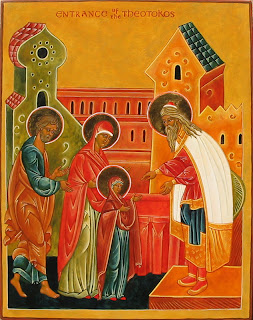
Presentation of the Blessed Virgin Mary


From a sermon by Saint Augustine

By faith she believed; by faith, conceived
Presentation of the Blessed Virgin Mary  
Stretching out his hand over his disciples, the Lord Christ declared: Here are my mother and my brothers; anyone who does the will of my Father who sent me is my brother and sister and my mother. I would urge you to ponder these words. Did the Virgin Mary, who believed by faith and conceived by faith, who was the chosen one from whom our Saviour was born among men, who was created by Christ before Christ was created in her – did she not do the will of the Father? Indeed the blessed Mary certainly did the Father’s will, and so it was for her a greater thing to have been Christ’s disciple than to have been his mother, and she was more blessed in her discipleship than in her motherhood. Hers was the happiness of first bearing in her womb him whom she would obey as her master.
  Now listen and see if the words of Scripture do not agree with what I have said. The Lord was passing by and crowds were following him. His miracles gave proof of divine power. and a woman cried out: Happy is the womb that bore you, blessed is that womb! But the Lord, not wishing people to seek happiness in a purely physical relationship, replied: More blessed are those who hear the word of God and keep it. Mary heard God’s word and kept it, and so she is blessed. She kept God’s truth in her mind, a nobler thing than carrying his body in her womb. The truth and the body were both Christ: he was kept in Mary’s mind insofar as he is truth, he was carried in her womb insofar as he is man; but what is kept in the mind is of a higher order than what is carried in the womb.
  The Virgin Mary is both holy and blessed, and yet the Church is greater than she. Mary is a part of the Church, a member of the Church, a holy, an eminent – the most eminent – member, but still only a member of the entire body. The body undoubtedly is greater than she, one of its members. This body has the Lord for its head, and head and body together make up the whole Christ. In other words, our head is divine – our head is God.
  Now, beloved, give me your whole attention, for you also are members of Christ; you also are the body of Christ. Consider how you yourselves can be among those of whom the Lord said: Here are my mother and my brothers. Do you wonder how you can be the mother of Christ? He himself said: Whoever hears and fulfils the will of my Father in heaven is my brother and my sister and my mother. As for our being the brothers and sisters of Christ, we can understand this because although there is only one inheritance and Christ is the only Son, his mercy would not allow him to remain alone. It was his wish that we too should be heirs of the Father, and co-heirs with himself.
  Now having said that all of you are brothers of Christ, shall I not dare to call you his mother? Much less would I dare to deny his own words. Tell me how Mary became the mother of Christ, if it was not by giving birth to the members of Christ? You, to whom I am speaking, are the members of Christ. Of whom were you born? “Of Mother Church,” I hear the reply of your hearts. You became sons of this mother at your baptism, you came to birth then as members of Christ. Now you in your turn must draw to the font of baptism as many as you possibly can. You became sons when you were born there yourselves, and now by bringing others to birth in the same way, you have it in your power to become the mothers of Christ.

Wednesday, November 19, 2014

Thursday of the 33rd week in ordinary time


From a sermon by Saint Augustine

The heart of the just man will rejoice in the Lord
 
The just man will rejoice in the Lord and put his hope in him; the hearts of all good men will be filled with joy. We must surely have sung these words with our hearts as well as with our voices. Indeed, the tongue of the Christian expresses his deepest feelings when it addresses such words to God. The just man will rejoice, not in the world, but in the Lord. Light has dawned for the just, Scripture says in another place, and joy for the upright of heart. Were you wondering what reason he has for joy? Here you are told: The just man will rejoice in the Lord. Another text runs: Delight in the Lord, and he will give you your heart’s desires.
  What are we instructed to do then, and what are we enabled to do? To rejoice in the Lord. But who can rejoice in something he does not see? Am I suggesting that we see the Lord then? No, but we have been promised that we shall see him. Now, as long as we are in the body, we walk by faith, for we are absent from the Lord. We walk by faith, and not by sight. When will it be by sight? Beloved, says John, we are now the sons of God; what we shall be has not yet been revealed, but we know that when it is revealed we shall be like him, because we shall see him as he is. When this prophecy is fulfilled, then it will be by sight.
  That will be the great joy, the supreme joy, joy in all its fullness. Then we shall no longer drink the milk of hope, but we shall feed on the reality itself. Nevertheless, even now, before that vision comes to us, or before we come to that vision, let us rejoice in the Lord; for it is no small reason for rejoicing to have a hope that will some day be fulfilled.
  Therefore, since the hope we now have inspires love, the just man rejoices, Scripture says, in the Lord; but because he does not yet see, it immediately goes on to say, and hopes in him.
  Yet already we have the first fruits of the Spirit, and have we not also other reasons for rejoicing? For we are drawing near to the one we love, and not only are we drawing near – we even have some slight feeling and taste of the banquet we shall one day eagerly eat and drink.
  But how can we rejoice in the Lord if he is far from us? Pray God he may not be far. If he is, that is your doing. Love, and he will draw near; love, and he will dwell within you. The Lord is at hand; have no anxiety. Are you puzzled to know how it is that he will be with you if you love? God is love.
  “What do you mean by love?” you will ask me. It is that which enables us to be loving. What do we love? A good that words cannot describe, a good that is for ever giving, a good that is the Creator of all good. Delight in him from whom you have received everything that delights you. But in that I do not include sin, for sin is the one thing that you do not receive from him. With that one exception, everything you have comes from him.

Wednesday of the 33rd week in ordinary time


From a sermon by Saint Augustine

The heart of the just man will rejoice in the Lord
The just man will rejoice in the Lord and put his hope in him; the hearts of all good men will be filled with joy. We must surely have sung these words with our hearts as well as with our voices. Indeed, the tongue of the Christian expresses his deepest feelings when it addresses such words to God. The just man will rejoice, not in the world, but in the Lord. Light has dawned for the just, Scripture says in another place, and joy for the upright of heart. Were you wondering what reason he has for joy? Here you are told: The just man will rejoice in the Lord. Another text runs: Delight in the Lord, and he will give you your heart’s desires.
  What are we instructed to do then, and what are we enabled to do? To rejoice in the Lord. But who can rejoice in something he does not see? Am I suggesting that we see the Lord then? No, but we have been promised that we shall see him. Now, as long as we are in the body, we walk by faith, for we are absent from the Lord. We walk by faith, and not by sight. When will it be by sight? Beloved, says John, we are now the sons of God; what we shall be has not yet been revealed, but we know that when it is revealed we shall be like him, because we shall see him as he is. When this prophecy is fulfilled, then it will be by sight.
  That will be the great joy, the supreme joy, joy in all its fullness. Then we shall no longer drink the milk of hope, but we shall feed on the reality itself. Nevertheless, even now, before that vision comes to us, or before we come to that vision, let us rejoice in the Lord; for it is no small reason for rejoicing to have a hope that will some day be fulfilled.
  Therefore, since the hope we now have inspires love, the just man rejoices, Scripture says, in the Lord; but because he does not yet see, it immediately goes on to say, and hopes in him.
  Yet already we have the first fruits of the Spirit, and have we not also other reasons for rejoicing? For we are drawing near to the one we love, and not only are we drawing near – we even have some slight feeling and taste of the banquet we shall one day eagerly eat and drink.
  But how can we rejoice in the Lord if he is far from us? Pray God he may not be far. If he is, that is your doing. Love, and he will draw near; love, and he will dwell within you. The Lord is at hand; have no anxiety. Are you puzzled to know how it is that he will be with you if you love? God is love.
  “What do you mean by love?” you will ask me. It is that which enables us to be loving. What do we love? A good that words cannot describe, a good that is for ever giving, a good that is the Creator of all good. Delight in him from whom you have received everything that delights you. But in that I do not include sin, for sin is the one thing that you do not receive from him. With that one exception, everything you have comes from him.

Tuesday, November 18, 2014

Tuesday of week 33 in Ordinary Time


A discourse by St Andrew of Crete

Behold, your king is coming to you, the Holy One, the Savior
Blessed is he who comes in the name of the Lord
 
Let us say to Christ: Blessed is he who comes in the name of the Lord, the king of Israel. Let us hold before him like palm branches those final words inscribed above the cross. Let us show him honour, not with olive branches but with the splendour of merciful deeds to one another. Let us spread the thoughts and desires of our hearts under his feet like garments, so that entering us with the whole of his being, he may draw the whole of our being into himself and place the whole of his in us. Let us say to Zion in the words of the prophet: Have courage, daughter of Zion, do not be afraid. Behold, your king comes to you, humble and mounted on a colt, the foal of a beast of burden.
  He is coming who is everywhere present and pervades all things; he is coming to achieve in you his work of universal salvation. He is coming who came to call to repentance not the righteous but sinners, coming to recall those who have strayed into sin. Do not be afraid, then: God is in the midst of you, and you shall not be shaken.
  Receive him with open, outstretched hands, for it was on his own hands that he sketched you. Receive him who laid your foundations on the palms of his hands. Receive him, for he took upon himself all that belongs to us except sin, to consume what is ours in what is his. Be glad, city of Zion, our mother, and fear not. Celebrate your feasts. Glorify him for his mercy, who has come to us in you. Rejoice exceedingly, daughter of Jerusalem, sing and leap for joy. Be enlightened, be enlightened, we cry to you, as holy Isaiah trumpeted, for the light has come to you and the glory of the Lord has risen over you.
  What kind of light is this? It is that which enlightens every man coming into the world. It is the everlasting light, the timeless light revealed in time, the light manifested in the flesh although hidden by nature, the light that shone round the shepherds and guided the Magi. It is the light that was in the world from the beginning, through which the world was made, yet the world did not know it. It is that light which came to its own, and its own people did not receive it.
  And what is this glory of the Lord? Clearly it is the cross on which Christ was glorified, he, the radiance of the Father’s glory, even as he said when he faced his passion: Now is the Son of Man glorified, and God is glorified in him, and will glorify him at once. The glory of which he speaks here is his lifting up on the cross, for Christ’s glory is his cross and his exultation upon it, as he plainly says: When I have been lifted up, I will draw all men to myself.

Monday, November 17, 2014

Saint Elizabeth of Hungary, Religious


From a letter of Conrad of Marburg, Saint Elizabeth's spiritual director

Elizabeth recognized and loved Christ in the poor
 
 
From this time onward Elizabeth’s goodness greatly increased. She was a lifelong friend of the poor and gave herself entirely to relieving the hungry. She ordered that one of her castles should be converted into a hospital in which she gathered many of the weak and feeble. She generously gave alms to all who were in need, not only in that place but in all the territories of her husband’s empire. She spent all her own revenue from her husband’s four principalities, and finally she sold her luxurious’ possessions and rich clothes for the sake of the poor.
  Twice a day, in the morning and in the evening, Elizabeth went to visit the sick. She personally cared for those who were particularly repulsive; to some she gave food, to others clothing; some she carried on her own shoulders, and performed many other kindly services. Her husband, of happy memory, gladly approved of these charitable works. Finally, when her husband died, she sought the highest perfection; filled with tears, she implored me to let her beg for alms from door to door.
  On Good Friday of that year, when the altars had been stripped, she laid her hands on the altar in a chapel in her own town, where she had established the Friars Minor, and before witnesses she voluntarily renounced all worldly display and everything that our Saviour in the gospel advises us to abandon. Even then she saw that she could still be distracted by the cares and worldly glory which had surrounded her while her husband was alive. Against my will she followed me to Marburg. Here in the town she built a hospice where she gathered together the weak and the feeble. There she attended the most wretched and contemptible at her own table.
  Apart from those active good works, I declare before God that I have seldom seen a more contemplative woman. When she was coming from private prayer, some religious men and women often saw her face shining marvelously and light coming from her eyes like the rays of the sun.
  Before her death I heard her confession. When I asked what should be done about her goods and possessions, she replied that anything which seemed to be hers belonged to the poor. She asked me to distribute everything except one worn out dress in which she wished to be buried. When all this had been decided, she received the body of our Lord. Afterward, until vespers, she spoke often of the holiest things she had heard in sermons. Then, she devoutly commended to God all who were sitting near her, and as if falling into a gentle sleep, she died.

Sunday, November 16, 2014

Sunday of the 33rd week in ordinary time


A commentary of St Augustine on Psalm 95

Let us not resist the first advent, and the second will not terrify us
Then all the trees of the forest will exult before the face of the Lord, for he has come, he has come to judge the earth. He has come the first time, and he will come again. At his first coming, his own voice declared in the gospel: Hereafter you shall see the Son of Man coming upon the clouds. What does he mean by hereafter? Does he not mean that the Lord will come at a future time when all the nations of the earth will be striking their breasts in grief? Previously he came through his preachers, and he filled the whole world. Let us not resist his first coming, so that we may not dread the second.
  What then should the Christian do? He ought to use the world, not become its slave. And what does this mean? It means having, as though not having. So says the Apostle: My brethren, the appointed time is short: from now on let those who have wives live as though they had none; and those who mourn as though they were not mourning; and those who rejoice as though they were not rejoicing; and those who buy as though they had no goods; and those who deal with this world as though they had no dealings with it. For the form of this world is passing away. But I wish you to be without anxiety. He who is without anxiety waits without fear until his Lord comes. For what sort of love of Christ is it to fear his coming? Brothers, do we not have to blush for shame? We love him, yet we fear his coming. Are we really certain that we love him? Or do we love our sins more? Therefore let us hate our sins and love him who will exact punishment for them. He will come whether we wish it or not. Do not think that because he is not coming just now, he will not come at all. He will come, you know not when; and provided he finds you prepared, your ignorance of the time of his coming will not be held against you.
  All the trees of the forest will exult. He has come the first time, and he will come again to judge the earth; he will find those rejoicing who believed in his first coming, for he has come.
  He will judge the world with equity and the peoples in his truth. What are equity and truth? He will gather together with him for the judgement his chosen ones, but the others he will set apart; for he will place some on his right, others on his left. What is more equitable, what more true than that they should not themselves expect mercy from the judge, who themselves were unwilling to show mercy before the judge’s coming. Those, however, who were willing to show mercy will be judged with mercy. For it will be said to those placed on his right: Come, blessed of my Father, take possession of the kingdom which has been prepared for you from the beginning of the world. And he reckons to their account their works of mercy: For I was hungry and you gave me food to eat; I was thirsty and you gave me drink.
  What is imputed to those placed on his left side? That they refused to show mercy. And where will they go? Depart into the everlasting fire. The hearing of this condemnation will cause much wailing. But what has another psalm said? The just man will be held in everlasting remembrance; he will not fear the evil report. What is the evil report? Depart into the everlasting fire, which was prepared for the devil and his angels. Whoever rejoices to hear the good report will not fear the bad. This is equity, this is truth.
  Or do you, because you are unjust, expect the judge not to be just? Or because you are a liar, will the truthful one not be true? Rather, if you wish to receive mercy, be merciful before he comes; forgive whatever has been done against you; give of your abundance. Of whose possessions do you give, if not from his? If you were to give of your own, it would be largess; but since you give of his, it is restitution. For what do you have, that you have not received? These are the sacrifices most pleasing to God: mercy, humility, praise, peace, charity. Such as these, then, let us bring and, free from fear, we shall await the coming of the judge who will judge the world in equity and the peoples in his truth.

Saturday, November 15, 2014

Saint Albert the Great, Bishop, Doctor


St Albert the Great's commentary on the Gospel according to Luke.

A shepherd and a teacher for the building of Christ's body
 
Do this in remembrance of me. Two things should be noted here. The first is the command that we should use this sacrament, which is indicated when he says: Do this. The second is that this sacrament commemorates the Lord’s going to death for our sake.
  So he says, Do this. Certainly he would demand nothing more profitable, nothing more pleasant, nothing more beneficial, nothing more desirable, nothing more similar to eternal life. We will look at each of these qualities separately.
  This sacrament is profitable because it grants remission of sins; it is most useful because it bestows the fullness of grace on us in this life. The Father of spirits instructs us in what is useful for us to receive his sanctification. And his sanctification is in Christ’s sacrifice, that is, when he offers himself in this sacrament to the Father for our redemption, to us for our use. I consecrate myself for their sakes. Christ, who through the Holy Spirit offered himself up without blemish to God, will cleanse our consciences from dead works to worship the living God.
  Nor can we do anything more pleasant. For what is better than God manifesting his whole sweetness to us. You gave them bread from heaven, not the fruit of human labor, but a bread endowed with all delight and pleasant to every sense of taste. For this substance of yours revealed your kindness toward your children, and serving the desire of each recipient, it changed to suit each one’s taste.
  He could not have commanded anything more beneficial, for this sacrament is the fruit of the tree of life. Anyone who receives this sacrament with the devotion of sincere faith will never taste death. It is a tree of life for those who grasp it, and blessed is he who holds it fast. The man who feeds on me shall live on account of me.
  Nor could he have commanded anything more lovable, for this sacrament produces love and union. It is characteristic of the greatest love to give itself as food. Had not the men of my tent exclaimed: Who will feed us with his flesh to satisfy our hunger? as if to say: I have loved them and they have loved me so much that I desire to be within them, and they wish to receive me so that they may become my members. There is no more intimate or more natural means for them to be united to me, and I to them.
  Nor could he have commanded anything which is more like eternal life. Eternal life flows from this sacrament because God with all sweetness pours himself out upon the blessed.

Friday, November 14, 2014

Friday of the 32nd week in ordinary time


A sermon of the second century

Let us turn to God, who has called us
The advice I have given about continence is by no means unimportant. If someone follow it he will not be sorry: he will save himself and me too, as the giver of this advice. It is no small reward, to take a lost and wandering soul and bring it to safety. For this is how we can pay God back for creating us, by making sure that whoever speaks or listens, speaks or listens in faith and love.
  Let us keep firm in what we believe, in righteousness and holiness, so that we can trustingly pray to the God who told us Even while you are still speaking I will answer, Behold, I am here. This saying is a sign of a great promise, because it says that God is quicker to give than we are to ask. Since we all have a share in his generosity, let us not be envious of one another for receiving such great blessings. For just as these words bring happiness to those who follow them, so do they bring condemnation to those who do not.
  So, brethren, this is no small opportunity for penitence that we have been given. Let us take advantage of it, let us turn to God who has called us, while we still have time, while we have someone who will receive us. If we renounce these desires and we conquer our souls and do not follow their evil impulses, we shall share in Jesus’s mercy. But be aware that the day of judgement is coming, a day like a blazing furnace, that a part of the heavens and the entire earth like lead melting in a fire, and all the deeds of men will be revealed, whether they were hidden or open. Therefore almsgiving is good, as penance for sin: fasting is better than prayer but almsgiving is better than both. Charity covers a multitude of sins, but prayer done with a good conscience liberates us from death. Blessed is anyone who is perfect in these ways: for almsgiving lifts the weight of sin.
  So let us do penance wholeheartedly, lest any one of us perish. For if we have been commanded to draw people away from the worship of idols, and to teach them, how much more important it must be that a soul that already knows God should not perish. Let us help one another so that we lead even the weak to goodness, so that we may all be saved, may be converted together and guide each other.

Thursday, November 13, 2014

Thursday of the 32nd week in ordinary time


A sermon of the second century
The living church is the body of Christ
 
My name is constantly blasphemed by unbelievers, says the Lord. Woe to the man who causes my name to be blasphemed. Why is the Lord’s name blasphemed? Because we say one thing and do another. When they hear the words of God on our lips, unbelievers are amazed at their beauty and power, but when they see that those words have no effect in our lives, their admiration turns to scorn, and they dismiss such words as myths and fairy tales.
  They listen, for example, when we tell them that God has said: It is no credit to you if you love those who love you, but only if you love your enemies, and those who hate you. They are full of admiration at such extraordinary virtue, but when they observe that we not only fail to love people who hate us, but even those who love us, they laugh us to scorn, and the Name is blasphemed.
  Therefore, brothers, if we do the will of God the Father, we shall be members of the first spiritual Church that was created before the sun and the moon; but if we fail to do the will of the Lord, we shall be among those to whom it is said in Scripture: My house has been made into a robbers’ den. We must choose then, if we want to be saved, to be members of the Church of life.
  You surely cannot be ignorant of the fact that the living Church is the body of Christ; for Scripture says: God made man male and female. Now the male signifies Christ, and the female signifies the Church, which, according to both the Old and New Testament, is no recent creation, but has existed from the beginning. At first the Church was purely spiritual, even as our Jesus was spiritual, but it appeared in the last days to save us.
  For the spiritual Church was made manifest in the body of Christ, in order to show us that if we uphold its honour in the outward, visible form, and do not defile it, we shall, through the Holy Spirit, be made its members in the true, spiritual sense. For the body of the Church is a copy of the Spirit, and no one who defaces the copy can have any part in what the copy represents. In other words, brothers, you must preserve the honour of the body in order to share in the Spirit. For if we say that the body is the Church and the Spirit is Christ, it follows that anyone who dishonours his body, dishonours the Church. Such a man will have no part in the Spirit, which is Christ. But if the Holy Spirit is joined to it, this body can receive an immortal life that is wonderful beyond words, for the blessings that God has made ready for his chosen ones surpass all human powers of description.

Wednesday, November 12, 2014

Saint Josaphat, Bishop, Martyr

Pope Pius XI's encyclical "Ecclesiam Dei"

He gave his life for the unity of the Church
In designing his Church God worked with such skill that in the fullness of time it would resemble a single great family embracing all men. It can be identified, as we know, by certain distinctive characteristics, notably its universality and unity.
  Christ the Lord passed on to his apostles the task he had received from the Father: I have been given all authority in heaven and on earth. Go, therefore, and make disciples of all nations. He wanted the apostles as a body to be intimately bound together, first by the inner tie of the same faith and love which flows into our hearts through the Holy Spirit, and, second, by the external tie of authority exercised by one apostle over the others. For this he assigned the primacy to Peter, the source and visible basis of their unity for all time. So that the unity and agreement among them would endure, God wisely stamped them, one might say, with the mark of holiness and martyrdom.
  Both these distinctions fell to Josaphat, archbishop of Polock of the Slavonic rite of the Eastern Church. He is rightly looked upon as the great glory and strength of the Eastern Rite Slavs. Few have brought them greater honor or contributed more to their spiritual welfare than Josaphat, their pastor and apostle, especially when he gave his life as a martyr for the unity of the Church. He felt, in fact, that God had inspired him to restore world-wide unity to the Church and he realized that his greatest chance of success lay in preserving the Slavonic rite and Saint Basil’s rule of monastic life within the one universal Church.
  Concerned mainly with seeing his own people reunited to the See of Peter, he sought out every available argument which would foster and maintain Church unity. His best arguments were drawn from liturgical books, sanctioned by the Fathers of the Church, which were in common use among Eastern Christians, including the dissidents. Thus thoroughly prepared, he set out to restore the unity of the Church. A forceful man of fine sensibilities, he met with such success that his opponents dubbed him “the thief of souls.”

Tuesday, November 11, 2014

Saint Martin of Tours, Bishop


A letter of Sulpicius Severus

Martin was poor and humble
 
Martin knew long in advance the time of his death and he told his brethren that it was near. Meanwhile, he found himself obliged to make a visitation of the parish of Candes. The clergy of that church were quarrelling, and he wished to reconcile them. Although he knew that his days on earth were few, he did not refuse to undertake the journey for such a purpose, for he believed that he would bring his virtuous life to a good end if by his efforts peace was restored in the church.
  He spent some time in Candes, or rather in its church, where he stayed. Peace was restored, and he was planning to return to his monastery when suddenly he began to lose his strength. He summoned his brethren and told them he was dying. All who heard this were overcome with grief. In their sorrow they cried to him with one voice: “Father, why are you deserting us? Who will care for us when you are gone? Savage wolves will attack your flock, and who will save us from their bite when our shepherd is struck down? We know you long to be with Christ, but your reward is certain and will not be any less for being delayed. You will do better to show pity for us, rather than forsake us.”
  Thereupon he broke into tears, for he was a man in whom the compassion of our Lord was continually revealed. Turning to our Lord, he made this reply to their pleading: “Lord, if your people still need me, I am ready for the task; your will be done.”
  Here was a man words cannot describe. Death could not defeat him nor toil dismay him. He was quite without a preference of his own; he neither feared to die nor refused to live. With eyes and hands always raised to heaven he never withdrew his unconquered spirit from prayer. It happened that some priests who had gathered at his bedside suggested that he should give his poor body some relief by lying on his other side. He answered: “Allow me, brothers, to look toward heaven rather than at the earth, so that my spirit may set on the right course when the time comes for me to go on my journey to the Lord.” As he spoke these words, he saw the devil standing near. “Why do you stand there, you bloodthirsty brute?” he cried. “Murderer, you will not have me for your prey. Abraham is welcoming me into his embrace.”
  With these words, he gave up his spirit to heaven. Filled with joy, Martin was welcomed by Abraham. Thus he left this life a poor and lowly man and entered heaven rich in God’s favour.

Monday, November 10, 2014

Saint Leo the Great, Pope, Doctor

A sermon of St Leo the Great

The special obligations of our ministry
 
 
Although the universal Church of God is constituted of distinct orders of members, still, in spite of the many parts of its holy body, the Church subsists as an integral whole, just as the Apostle says: We are all one in Christ. No difference in office is so great that anyone can be separated, through lowliness, from the head. In the unity of faith and baptism, therefore, our community is undivided. There is a common dignity, as the apostle Peter says in these words: And you are built up as living stones into spiritual houses, a holy priesthood, offering spiritual sacrifices which are acceptable to God through Jesus Christ. And again: But you are a chosen people, a royal priesthood, a holy nation, a people set apart.
  For all, regenerated in Christ, are made kings by the sign of the cross; they are consecrated priests by the oil of the Holy Spirit, so that beyond the special service of our ministry as priests, all spiritual and mature Christians know that they are a royal race and are sharers in the office of the priesthood. For what is more king-like than to find yourself ruler over your body after having surrendered your soul to God? And what is more priestly than to promise the Lord a pure conscience and to offer him in love unblemished victims on the altar of one’s heart?
  Because, through the grace of God, it is a deed accomplished universally on behalf of all, it is altogether praiseworthy and in keeping with a religious attitude for you to rejoice in this our day of consecration, to consider it a day when we are especially honored. For indeed one sacramental priesthood is celebrated throughout the entire body of the Church. The oil which consecrates us has richer effects in the higher grades, yet it is not sparingly given in the lower.
  Sharing in this office, my dear brethren, we have solid ground for a common rejoicing; yet there will be more genuine and excellent reason for joy if you do not dwell on the thought of our unworthiness. It is more helpful and more suitable to turn your thoughts to study the glory of the blessed apostle Peter. We should celebrate this day above all in honor of him. He overflowed with abundant riches from the very source of all graces, yet though he alone received much, nothing was given over to him without his sharing it. The Word made flesh lived among us, and in redeeming the whole human race, Christ gave himself entirely.

Sunday, November 9, 2014

dedication of the Lateran Basilica

A sermon of St Caesarius of Arles

Baptism makes every one of us into a temple of God.
My fellow Christians, today is the birthday of this church, an occasion for celebration and rejoicing. We, however, ought to be the true and living temple of God. Nevertheless, Christians rightly commemorate this feast of the church, their mother, for they know that through her they were reborn in the spirit. At our first birth, we were vessels of God’s wrath; reborn, we became vessels of his mercy. Our first birth brought death to us, but our second restored us to life.
  Indeed, before our baptism we were sanctuaries of the devil; but after our baptism we merited the privilege of being temples of Christ. And if we think more carefully about the meaning of our salvation, we shall realise that we are indeed living and true temples of God. God does not dwell only in things made by human hands, nor in homes of wood and stone, but rather he dwells principally in the soul made according to his own image and fashioned by his own hand. Therefore, the apostle Paul says: The temple of God is holy, and you are that temple.
  When Christ came, he banished the devil from our hearts, in order to build in them a temple for himself. Let us therefore do what we can with his help, so that our evil deeds will not deface that temple. For whoever does evil, does injury to Christ. As I said earlier, before Christ redeemed us, we were the house of the devil, but afterward, we merited the privilege of being the house of God. God himself in his loving mercy saw fit to make of us his own home. My fellow Christians, do we wish to celebrate joyfully the birth of this temple? Then let us not destroy the living temples of God in ourselves by works of evil. I shall speak clearly, so that all can understand. Whenever we come to church, we must prepare our hearts to be as beautiful as we expect this church to be. Do you wish to find this basilica immaculately clean? Then do not soil your soul with the filth of sins. Do you wish this basilica to be full of light? God too wishes that your soul be not in darkness, but that the light of good works shine in us, so that he who dwells in the heavens will be glorified. Just as you enter this church building, so God wishes to enter into your soul, for he promised: I shall live in them, I shall walk through their hearts.

Saturday, November 8, 2014

Saturday of the 31st day in ordinary time


St Ambrose, On The Blessing of Death

On the blessing of death
St Paul says, The world is crucified to me, and I to the world. Then he tells us that he means death in this life, and a good death: We carry with us in our body the death of Jesus, so that the life of our Lord Jesus, too, may always be seen in our body.
  Let death do its work in us, therefore, so that life may do its work also: a good life after death, that is, a good life after victory, after the battle is over, when the law of the flesh is no longer in conflict with the law of the mind, when we have no more battles with mortal flesh but in mortal flesh we have victory. I wonder if this death might not have more power in it than life. St Paul’s authority certainly suggests it when he says Death works in us but life in you.
  One man’s death has laid the foundations of life for so many people! And so St Paul teaches that we should seek that death in this life, so that Christ’s death should shine out in our bodies. That blessed death, in which our outer nature falls away and our inner nature is renewed, and our earthly dwelling is dissolved so that our heavenly home is laid open to us.
  A man imitates this death when he drags himself away from being part of this flesh and breaks those chains that the Lord had spoken of through the prophet Isaiah: Break unjust fetters, undo the thongs of the yoke, let the oppressed go free, and break every unjust constraint.
  It was to put an end to guilt that the Lord permitted death to come into the world; but so that human nature should not end up perishing by death instead of guilt, the resurrection of the dead was given us. By death, guilt would be ended, and by resurrection, human nature would be eternal.
  And thus this death is a journey for everyone. You must always be journeying: from decay to incorruptibility, from mortality to immortality, from turbulence to peace. Do not be alarmed by the word ‘death’ but rejoice at the good that the journey will bring. For what is death except the burial of vice and the raising up of virtue? Hence Scripture says, May I die the death of the just – that is, may I be buried with them, put down my vices, and put on the grace of the just, who carry the mortification of Christ around in their bodies and their souls.

Friday, November 7, 2014

Almost


made it through the Malaria season with very few patients........ however because the rains were quite late and so were/are the mosquitoes. It is just in the past 3 weeks that the malaria patients are coming to Nazareth...last year, at this time, we had already seen the last of the patients with malaria. But...no matter it is still here and today we finally emptied our store of the malaria cure-all (Coartem).
This is still a big problem here and I am, once again, asking for your help in order to buy more medicine for the folks with malaria.
Now, having just experienced my own malaria, I can assure you that it is horrible. Headache, painful joints, vomiting are all part of it and until the patients are cured they will suffer 24 hours a day. I can understand why people come into Nazareth and drop right down to the floor or why they can't control their vomiting. My sandals will attest to that.
1 curative dose is nearly 2 dalasis. Donations were such a big help to us but now, because we took credit for a lot more, the wolves are at the gate. Until that credit is paid off we cannot purchase medicines and that will be BAD.
So I beg your kind help again. Any medicine that is not used can be saved for next years season so it will not go to waste. It is from these donations that I was able to take the 3 day cure and I still ended up in the Hospital ( I had pneumonia on top of the malaria)

Please help us help these folks...they are our brothers and sisters.

God bless you,

Brother dismas Mary

Friday of the 31st week in Ordinary time


A sermon by St Gregory Nazianzen

It is a holy thought to pray for the dead
 
What is man, that you are mindful of him? What is this new mystery surrounding me? I am both small and great, both lowly and exalted, mortal and immortal, earthly and heavenly. I am to be buried with Christ and to rise again with him, to become a co-heir with him, a son of God, and indeed God himself.
  This is what the great mystery means for us; this is why God became man and became poor for our sake: it was to raise up our flesh, to recover the divine image, to re-create mankind, so that all of us might become one in Christ who perfectly became in us everything that he is himself. So we are no longer to be male and female, barbarian and Scythian, slave and free – distinctions deriving from the flesh – but are to bear within ourselves only the seal of God, by whom and for whom we were created. We are to be so formed and molded by him that we are recognized as belonging to his one family.
  If only we could be what we hope to be, by the great kindness of our generous God! He asks so little and gives so much, in this life and in the next, to those who love him sincerely. In a spirit of hope and out of love for him, let us then bear and endure all things and give thanks for everything that befalls us, since even reason can often recognize these things as weapons to win salvation. And meanwhile let us commend to God our own souls and the souls of those who, being more ready for it, have reached the place of rest before us although they walked the same road as we do.
  Lord and Creator of all, and especially of your creature man, you are the God and Father and ruler of your children; you are the Lord of life and death, you are the guardian and benefactor of our souls. You fashion and transform all things in their due season through your creative Word, as you know to be best in your deep wisdom and providence. Receive now those who have gone ahead of us in our journey from this life.
  And receive us too at the proper time, when you have guided us in our bodily life as long as may be for our profit. Receive us prepared indeed by fear of you, but not troubled, not shrinking back on that day of death or uprooted by force like those who are lovers of the world and the flesh. Instead, may we set out eagerly for that everlasting and blessed life which is in Christ Jesus our Lord. To him be glory for ever and ever. Amen.