Thursday, December 4, 2014

Saint John Damascene, Priest, Doctor


The declaration of faith of St John Damascene


You called me, Lord, to minister to your people
O Lord, you led me from my father’s loins and formed me in my mother’s womb. You brought me, a naked babe, into the light of day, for nature’s laws always obey your commands.
  By the blessing of the Holy Spirit, you prepared my creation and my existence, not because man willed it or flesh desired it, but by your ineffable grace. The birth you prepared for me was such that it surpassed the laws of our nature. You sent me forth into the light by adopting me as your son and you enrolled me among the children of your holy and spotless Church.
  You nursed me with the spiritual milk of your divine utterances. You kept me alive with the solid food of the body of Jesus Christ, your only-begotten Son and our God, and you let me drink from the chalice of his life-giving blood, poured out to save the whole world.
  You loved us, O Lord, and gave up your only-begotten Son for our redemption. And he undertook the task willingly and did not shrink from it. Indeed, he applied himself to it as though destined for sacrifice, like an innocent lamb. Although he was God, he became man, and in his human will, became obedient to you, God his Father, unto death, even death on a cross.
  In this way you have humbled yourself, Christ my God, so that you might carry me, your stray sheep, on your shoulders. You let me graze in green pastures, refreshing me with the waters of orthodox teaching at the hands of your shepherds. You pastured these shepherds, and now they in turn tend your chosen and special flock. Now you have called me, Lord, by the hand of your bishop to minister to your people. I do not know why you have done so, for you alone know that. Lord, lighten the heavy burden of the sins through which I have seriously transgressed. Purify my mind and heart. Like a shining lamp, lead me along the straight path. When I open my mouth, tell me what I should say. By the fiery tongue of your Spirit make my own tongue ready. Stay with me always and keep me in your sight.
  Lead me to pastures, Lord, and graze there with me. Do not let my heart lean either to the right or to the left, but let your good Spirit guide me along the straight path. Whatever I do, let it be in accordance with your will, now until the end.
  And you, O Church, are a most excellent assembly, the noble summit of perfect purity, whose assistance comes from God. You in whom God lives, receive from us an exposition of the faith that is free from error, to strengthen the Church, just as our Fathers handed it down to us.

Wednesday, December 3, 2014

Saint Francis Xavier, Priest


A letter from St Francis Xavier to St Ignatius

Woe to me if I do not preach the Gospel
Saint Francis Xavier

We have visited the villages of the new converts who accepted the Christian religion a few years ago. No Portuguese live here, the country is so utterly barren and poor. The native Christians have no priests. They know only that they are Christians. There is nobody to say Mass for them; nobody to teach them the Creed, the Our Father, the Hail Mary and the Commandments of God’s Law.
  I have not stopped since the day I arrived. I conscientiously made the rounds of the villages. I bathed in the sacred waters all the children who had not yet been baptized. This means that I have purified a very large number of children so young that, as the saying goes, they could not tell their right hand from their left. The older children would not let me say my Office or eat or sleep until I taught them one prayer or another. Then I began to understand: “The kingdom of heaven belongs to such as these.”
  I could not refuse so devout a request without failing in devotion myself. I taught them, first the confession of faith in the Father, the Son and the Holy Spirit, then the Apostles’ Creed, the Our Father and Hail Mary. I noticed among them persons of great intelligence. If only someone could educate them in the Christian way of life, I have no doubt that they would make excellent Christians.
  Many, many people hereabouts are not becoming Christians for one reason only: there is nobody to make them Christians. Again and again I have thought of going round the universities of Europe, especially Paris, and everywhere crying out like a madman, riveting the attention of those with more learning than charity: “What a tragedy: how many souls are being shut out of heaven and falling into hell, thanks to you!”
  I wish they would work as hard at this as they do at their books, and so settle their account with God for their learning and the talents entrusted to them.
  This thought would certainly stir most of them to meditate on spiritual realities, to listen actively to what God is saying to them. They would forget their own desires, their human affairs, and give themselves over entirely to God’s will and his choice. They would cry out with all their heart: Lord, I am here! What do you want me to do? Send me anywhere you like – even to India.

Tuesday, December 2, 2014

Tuesday of the 1st week of Advent


St Gregory Nazianzen
The wonder of the Incarnation
The very Son of God, older than the ages, the invisible, the incomprehensible, the incorporeal, the beginning of beginning, the light of light, the fountain of life and immortality, the image of the archetype, the immovable seal, the perfect likeness, the definition and word of the Father: he it is who comes to his own image and takes our nature for the good of our nature, and unites himself to an intelligent soul for the good of my soul, to purify like by like. He takes to himself all that is human, except for sin. He was conceived by the Virgin Mary, who had been first prepared in soul and body by the Spirit; his coming to birth had to be treated with honour, virginity had to receive new honor. He comes forth as God, in the human nature he has taken, one being, made of two contrary elements, flesh and spirit. Spirit gave divinity, flesh received it.
  He who makes rich is made poor; he takes on the poverty of my flesh, that I may gain the riches of his divinity. He who is full is made empty; he is emptied for a brief space of his glory, that I may share in his fullness. What is this wealth of goodness? What is this mystery that surrounds me? I received the likeness of God, but failed to keep it. He takes on my flesh, to bring salvation to the image, immortality to the flesh. He enters into a second union with us, a union far more wonderful than the first.
  Holiness had to be brought to man by the humanity assumed by one who was God, so that God might overcome the tyrant by force and so deliver us and lead us back to himself through the mediation of his Son. The Son arranged this for the honour of the Father, to whom the Son is clearly obedient in all things.
  The Good Shepherd, who lays down his life for the sheep, came in search of the straying sheep to the mountains and hills on which you used to offer sacrifice. When he found it, he took it on the shoulders that bore the wood of the cross, and led it back to the life of heaven.
  Christ, the light of all lights, follows John, the lamp that goes before him. The Word of God follows the voice in the wilderness; the bridegroom follows the bridegroom’s friend, who prepares a worthy people for the Lord by cleansing them by water in preparation for the Spirit.
  We needed God to take our flesh and die, that we might live. We have died with him, that we may be purified. We have risen again with him, because we have died with him. We have been glorified with him, because we have risen again with him.

Monday, December 1, 2014

Monday of the 1st week in Advent


A pastoral letter by St Charles Borromeo

The season of Advent
 
Beloved, now is the acceptable time spoken of by the Spirit, the day of salvation, peace and reconciliation: the great season of Advent. This is the time eagerly awaited by the patriarchs and prophets, the time that holy Simeon rejoiced at last to see. This is the season that the Church has always celebrated with special solemnity. We too should always observe it with faith and love, offering praise and thanksgiving to the Father for the mercy and love he has shown us in this mystery. In his infinite love for us, though we were sinners, he sent his only Son to free us from the tyranny of Satan, to summon us to heaven, to welcome us into its innermost recesses, to show us truth itself, to train us in right conduct, to plant within us the seeds of virtue, to enrich us with the treasures of his grace, and to make us children of God and heirs of eternal life.
  Each year, as the Church recalls this mystery, she urges us to renew the memory of the great love God has shown us. This holy season teaches us that Christ’s coming was not only for the benefit of his contemporaries; his power has still to be communicated to us all. We shall share his power, if, through holy faith and the sacraments, we willingly accept the grace Christ earned for us, and live by that grace and in obedience to Christ.
  The Church asks us to understand that Christ, who came once in the flesh, is prepared to come again. When we remove all obstacles to his presence he will come, at any hour and moment, to dwell spiritually in our hearts, bringing with him the riches of his grace.
  In her concern for our salvation, our loving mother the Church uses this holy season to teach us through hymns, canticles and other forms of expression, of voice or ritual, used by the Holy Spirit. She shows us how grateful we should be for so great a blessing, and how to gain its benefit: our hearts should be as much prepared for the coming of Christ as if he were still to come into this world. The same lesson is given us for our imitation by the words and example of the holy men of the Old Testament.

Sunday, November 30, 2014

1st Sunday of Advent


St Cyril of Jerusalem

The twofold coming of Christ
 
We do not preach only one coming of Christ, but a second as well, much more glorious than the first. The first coming was marked by patience; the second will bring the crown of a divine kingdom.
  In general, whatever relates to our Lord Jesus Christ has two aspects. There is a birth from God before the ages, and a birth from a virgin at the fullness of time. There is a hidden coming, like that of rain on fleece, and a coming before all eyes, still in the future.
  At the first coming he was wrapped in swaddling clothes in a manger. At his second coming he will be clothed in light as in a garment. In the first coming he endured the cross, despising the shame; in the second coming he will be in glory, escorted by an army of angels.
  We look then beyond the first coming and await the second. At the first coming we said: Blessed is he who comes in the name of the Lord. At the second we shall say it again; we shall go out with the angels to meet the Lord and cry out in adoration: Blessed is he who comes in the name of the Lord.
  The Saviour will not come to be judged again, but to judge those by whom he was judged. At his own judgement he was silent; then he will address those who committed the outrages against him when they crucified him and will remind them: You did these things, and I was silent.
  His first coming was to fulfil his plan of love, to teach men by gentle persuasion. This time, whether men like it or not, they will be subjects of his kingdom by necessity.
  The prophet Malachi speaks of the two comings. And the Lord whom you seek will come suddenly to his temple: that is one coming.
  Again he says of another coming: Look, the Lord almighty will come, and who will endure the day of his entry, or who will stand in his sight? Because he comes like a refiner’s fire, a fuller’s herb, and he will sit refining and cleansing.
  These two comings are also referred to by Paul in writing to Titus: The grace of God the Saviour has appeared to all men, instructing us to put aside impiety and worldly desires and live temperately, uprightly, and religiously in this present age, waiting for the joyful hope, the appearance of the glory of our great God and Saviour, Jesus Christ. Notice how he speaks of a first coming for which he gives thanks, and a second, the one we still await.
  That is why the faith we profess has been handed on to you in these words: He ascended into heaven, and is seated at the right hand of the Father, and he will come again in glory to judge the living and the dead, and his kingdom will have no end.
  Our Lord Jesus Christ will therefore come from heaven. He will come at the end of the world, in glory, at the last day. For there will be an end to this world, and the created world will be made new.

Saturday, November 29, 2014

Saturday of the 34th week in ordinary time


From a sermon by Saint Augustine

Let us sing Alleluia to God, who is good and frees us from evil
Let us sing alleluia here on earth, while we are still anxious and worrying, so that we may one day be able to sing it there in heaven, without any worry or care. Why anxious and worrying here? You must want me to be anxious, Lord, when I read, Is not man’s life on earth a trial and a temptation? You must want me to worry when temptation is so plentiful that the Prayer itself tells us to worry, when we say, Forgive us our trespasses as we forgive those that trespass against us. Every day we are petitioners, every day we are trespassers. Do you want me to throw care to the winds, Lord, when every day I am requesting pardon for sins and assistance against dangers? After all, when I have said, because of past sins, Forgive us our trespasses as we forgive those that trespass against us, I must immediately go on to add, because of future dangers, Lead us not into temptation. And how can a people be in a good way, when they cry out with me, Deliver us from evil? And yet, my brethren, in this time that is still evil, let us sing alleluia to the good God, who does deliver us from evil.
  Even here, among the dangers, among the trials and temptations of this life, both by others and by ourselves let alleluia be sung. God is faithful, he says, and he will not permit you to be tempted beyond what you are able to endure. So even here let us sing alleluia. Man is still a defendant on trial, but God is faithful. He did not say “he will not permit you to be tempted” but he will not permit you to be tempted beyond what you are able to endure; and with the temptation he will also make a way out, so that you may be able to endure it. You have entered into temptation; but God will also make a way out so that you do not perish in the temptation; so that like a potter’s jar you may be shaped by the preaching and fired into strength by the tribulation. But when you enter the temptation, bear in mind the way out: because God is faithful, God will watch over you and guard your going in and your coming out.
  Furthermore, when this body has become immortal and imperishable, when all temptation has been done away with; because the body is dead – why is it dead? – Because of sin. But the spirit is life, because of justice. So do we leave the body dead, then? No, but listen: But if the Spirit of him who raised Christ from the dead dwells within you, then he who raised Christ from the dead will give life to your mortal bodies. So you see: now the body receives its life from the soul, but then it will receive it from the Spirit.
  O! what a happy alleluia there, how carefree, how safe from all opposition, where nobody will be an enemy, where no-one will ever cease to be a friend! God’s praises sung there, sung here – here, by the anxious; there, by the carefree – here, by those who will die; there, by those who will live for ever – here, in hope; there, in reality – here, on our journey; there, in our homeland.
  So now, my brethren, let us sing, not to delight our leisure, but to ease our toil. In the way that travellers are in the habit of singing, sing, but keep on walking. What does it mean, “keep on walking”? Go onward always – but go onward in goodness, for there are, according to the Apostle, some people who go ever onward from bad to worse. If you are going onward, you are walking; but always go onward in goodness, onward in the right faith, onward in good habits and behaviour. Sing, and walk onwards.

Friday, November 28, 2014

Friday of the 34th week in Ordinary time


The treatise of St Cyprian on mortality

Let us shut out the fear of death and meditate upon immortality
Our obligation is to do God’s will, and not our own. We must remember this if the prayer that our Lord commanded us to say daily is to have any meaning on our lips. How unreasonable it is to pray that God’s will be done, and then not promptly obey it when he calls us from this world! Instead we struggle and resist like self-willed slaves and are brought into the Lord’s presence with sorrow and lamentation, not freely consenting to our departure, but constrained by necessity. And yet we expect to be rewarded with heavenly honours by him to whom we come against our will! Why then do we pray for the kingdom of heaven to come if this earthly bondage pleases us? What is the point of praying so often for its early arrival if we would rather serve the devil here than reign with Christ.
  The world hates Christians, so why give your love to it instead of following Christ, who loves you and has redeemed you? John is most urgent in his epistle when he tells us not to love the world by yielding to sensual desires. Never give your love to the world, he warns, or to anything in it. A man cannot love the Father and love the world at the same time. All that the world offers is the lust of the flesh, the lust of the eyes and earthly ambition. The world and its allurements will pass away, but the man who has done the will of God shall live for ever. Our part, my dear brothers, is to be single-minded, firm in faith, and steadfast in courage, ready for God’s will, whatever it may be. Banish the fear of death and think of the eternal life that follows it. That will show people that we really live our faith.
  We ought never to forget, beloved, that we have renounced the world. We are living here now as aliens and only for a time. When the day of our homecoming puts an end to our exile, frees us from the bonds of the world, and restores us to paradise and to a kingdom, we should welcome it. What man, stationed in a foreign land, would not want to return to his own country as soon as possible? Well, we look upon paradise as our country, and a great crowd of our loved ones awaits us there, a countless throng of parents, brothers and children longs for us to join them. Assured though they are of their own salvation, they are still concerned about ours. What joy both for them and for us to see one another and embrace! O the delight of that heavenly kingdom where there is no fear of death! O the supreme and endless bliss of everlasting life!
  There, is the glorious band of apostles, there the exultant assembly of prophets, there the innumerable host of martyrs, crowned for their glorious victory in combat and in death. There in triumph are the virgins who subdued their passions by the strength of continence. There the merciful are rewarded, those who fulfilled the demands of justice by providing for the poor. In obedience to the Lord’s command, they turned their earthly patrimony into heavenly treasure.
  My dear brothers, let all our longing be to join them as soon as we may. May God see our desire, may Christ see this resolve that springs from faith, for he will give the rewards of his love more abundantly to those who have longed for him more fervently.

Thursday, November 27, 2014

Thursday of the 34th week in ordinary time


A homily by St John Chrysostom
If we are sheep, we overcome; if wolves, we are overcome
As long as we are sheep, we overcome and, though surrounded by countless wolves, we emerge victorious; but if we turn into wolves, we are overcome, for we lose the shepherd’s help. He, after all, feeds the sheep not wolves, and will abandon you if you do not let him show his power in you.
  What he says is this: “Do not be upset that, as I send you out among the wolves, I bid you be as sheep and doves. I could have managed things quite differently and sent you, not to suffer evil nor to yield like sheep to the wolves, but to be fiercer than lions. But the way I have chosen is right. It will bring you greater praise and at the same time manifest my power.” That is what he told Paul: My grace is enough for you, for in weakness my power is made perfect. “I intend,” he says, “to deal in the same way with you.” For, when he says, I am sending you out like sheep, he implies: “But do not therefore lose heart, for I know and am certain that no one will be able to overcome you.”
  The Lord, however, does want them to contribute something, lest everything seem to be the work of grace, and they seem to win their reward without deserving it. Therefore he adds: You must be clever as snakes and innocent as doves. But, they may object, what good is our cleverness amid so many dangers? How can we be clever when tossed about by so many waves? However great the cleverness of the sheep as he stands among the wolves – so many wolves! – what can it accomplish? However great the innocence of the dove, what good does it do him, with so many hawks swooping upon him? To all this I say: Cleverness and innocence admittedly do these irrational creatures no good, but they can help you greatly.
  What cleverness is the Lord requiring here? The cleverness of a snake. A snake will surrender everything and will put up no great resistance even if its body is being cut in pieces, provided it can save its head. So you, the Lord is saying, must surrender everything but your faith: money, body, even life itself. For faith is the head and the root; keep that, and though you lose all else, you will get it back in abundance. The Lord therefore counselled the disciples to be not simply clever or innocent; rather he joined the two qualities so that they become a genuine virtue. He insisted on the cleverness of the snake so that deadly wounds might be avoided, and he insisted on the innocence of the dove so that revenge might not be taken on those who injure or lay traps for you. Cleverness is useless without innocence.
  Do not believe that this precept is beyond your power. More than anyone else, the Lord knows the true natures of created things; he knows that moderation, not a fierce defence, beats back a fierce attack.

Wednesday, November 26, 2014

Wednesday of the 34th week in ordinary time

A sermon said to be by St Macarius
Woe to the souls where Christ does not dwell!
When God was displeased with the Jews, he delivered Jerusalem to the enemy, and they were conquered by those who hated them; there were no more sacrifices or feasts. Likewise angered at a soul who had broken his commands, God handed it over to its enemies, who corrupted and totally dishonoured it. When a house has no master living in it, it becomes dark, vile and contemptible, choked with filth and disgusting refuse. So too is a soul which has lost its master, who once rejoiced there with his angels. This soul is darkened with sin, its desires are degraded, and it knows nothing but shame.
  Woe to the path that is not walked on, or along which the voices of men are not heard, for then it becomes the haunt of wild animals. Woe to the soul if the Lord does not walk within it to banish with his voice the spiritual beasts of sin. Woe to the house where no master dwells, to the field where no farmer works, to the pilotless ship, storm-tossed and sinking. Woe to the soul without Christ as its true pilot; drifting in the darkness, buffeted by the waves of passion, storm-tossed at the mercy of evil spirits, its end is destruction. Woe to the soul that does not have Christ to cultivate it with care to produce the good fruit of the Holy Spirit. Left to itself, it is choked with thorns and thistles; instead of fruit it produces only what is fit for burning. Woe to the soul that does not have Christ dwelling in it; deserted and foul with the filth of the passions, it becomes a haven for all the vices. When a farmer prepares to till the soil he must put on clothing and use tools that are suitable. So Christ, our heavenly king, came to till the soil of mankind devastated by sin. He assumed a body and, using the cross as his ploughshare, cultivated the barren soul of man. He removed the thorns and thistles which are the evil spirits and pulled up the weeds of sin. Into the fire he cast the straw of wickedness. And when he had ploughed the soul with the wood of the cross, he planted in it a most lovely garden of the Spirit, that could produce for its Lord and God the sweetest and most pleasant fruit of every kind.

Tuesday, November 25, 2014

Saint Catherine of Alexandria, Virgin, Martyr


A treatise of St Augustine on St John's gospel

You will come to the spring and see light itself
 
We Christians are the light, at least by comparison with unbelievers. Thus the Apostle says: Once you were darkness, but now you are light in the Lord; walk then as sons of the light. And elsewhere he says: The night is far spent, the day is drawing near. Let us therefore lay aside the works of darkness and put on the armor of light; let us walk uprightly as in the day.
  Nevertheless, since the days in which we are now living are still dark compared to the light which we shall see, hear what the apostle Peter says. He speaks of a voice that came from the Supreme Glory and said to the Lord Jesus Christ: You are my beloved Son in whom I am well pleased. This voice, he says, we heard coming from heaven, when we were with him on the holy mountain. Because we ourselves were not present there and did not hear that voice from heaven, Peter says to us: And we possess a more certain prophetic word to which you do well to attend, as to a lamp shining in a dark place, until the day dawns and the morning star rises in your hearts.
  When, therefore, our Lord Jesus Christ comes and, as the apostle Paul says, brings to light things hidden in darkness and makes plain the secrets of the heart, so that everyone may receive his commendation from God, then lamps will no longer be needed. When that day is at hand, the prophet will not be read to us, the book of the Apostle will not be opened, we shall not require the testimony of John, we shall have no need of the Gospel itself. Therefore all Scriptures will be taken away from us, those Scriptures which in the night of this world burned like lamps so that we might not remain in darkness.
  When all these things are removed as no longer necessary for our illumination, and when the men of God by whom they were ministered to us shall themselves together with us behold the true and dear light without such aids, what shall we see? With what shall our minds be nourished? What will give joy to our gaze? Where will that gladness come from, which eye has not seen, and ear has not heard, which has not even been conceived by the heart of man? What shall we see?
  I implore you to love with me and, by believing, to run with me; let us long for our heavenly country, let us sigh for our heavenly home, let us truly feel that here we are strangers. What shall we then see? Let the gospel tell us: In the beginning was the Word and the Word was with God and the Word was God. You will come to the fountain, with whose dew you have already been sprinkled. Instead of the ray of light which was sent through slanting and winding ways into the heart of your darkness, you will see the light itself in all its purity and brightness. It is to see and experience this light that you are now being cleansed. Dearly beloved, John himself says, we are the sons of God, and it has not yet been disclosed what we shall be; but we know that when he appears we shall be like him, because we shall see him as he is.
  I feel that your spirits are being raised up with mine to the heavens above; but the body which is corruptible weighs down the soul, and this earthly tent burdens the thoughtful mind. I am about to lay aside this book, and you are soon going away, each to his own business. It has been good for us to share the common light, good to have enjoyed ourselves, good to have been glad together. When we part from one another, let us not depart from him.

Monday, November 24, 2014

Saints Andrew Dũng-Lạc and his Companions, Martyrs


A letter of Saint Paul Le-Bao-Tinh

I am not alone: Christ is with me
 
I, Paul, in chains for the name of Christ, wish to relate to you the trials besetting me daily, in order that you may be inflamed with love for God and join with me in his praises. The prison here is a true image of everlasting hell: to cruel tortures of every kind – shackles, iron chains, manacles – are added hatred, vengeance, calumnies, obscene speech, quarrels, evil acts, swearing, curses, as well as anguish and grief. But the God who once freed the three children from the fiery furnace is with me always; he has delivered me from these tribulations and made them sweet, for his mercy is for ever.
  In the midst of these torments, which usually terrify others, I am, by the grace of God, full of joy and gladness, because I am not alone – Christ is with me.
  Our Master bears the whole weight of the cross, leaving me only the tiniest, last bit. He is not a mere onlooker in my struggle, but a contestant and the victor and champion in the whole battle. Therefore upon his head is placed the crown of victory, and his members also share in his glory.
  How am I to bear with the spectacle, as each day I see emperors, mandarins, and their retinue blaspheming your holy name, O Lord, who are enthroned above the cherubim and seraphim? Behold, the pagans have trodden your cross underfoot! Where is your glory? As I see all this, I would, in the ardent love I have for you, prefer to be torn limb from limb and to die as a witness to your love.
  O Lord, show your power, save me, sustain me, that in my infirmity your power may be shown and may be glorified before the nations; grant that I may not grow weak along the way, and so allow your enemies to hold their heads up in pride.
Our Lady of China
  Beloved brothers, as you hear all these things may you give endless thanks in joy to God, from whom every good proceeds; bless the Lord with me, for his mercy is for ever. My soul proclaims the greatness of the Lord, my spirit rejoices in God my saviour, for he has looked with favor on his lowly servant and from this day all generations will call me blessed, for his mercy is for ever.
  O praise the Lord, all you nations, acclaim him, all you peoples, for God chose what is weak in the world to confound the strong, God chose what is low and despised to confound the noble. Through my mouth he has confused the philosophers who are disciples of the wise of this world, for his mercy is for ever.
  I write these things to you in order that your faith and mine may be united. In the midst of this storm I cast my anchor toward the throne of God, the anchor that is the lively hope in my heart.
  Beloved brothers, for your part so run that you may attain the crown, put on the breastplate of faith and take up the weapons of Christ for the right hand and for the left, as my patron Saint Paul has taught us. It is better for you to enter life with one eye or crippled than, with all your members intact, to be cast away.
  Come to my aid with your prayers, that I may have the strength to fight according to the law, and indeed to fight the good fight and to fight until the end and so finish the race. We may not again see each other in this life, but we will have the happiness of seeing each other again in the world to come, when, standing at the throne of the spotless Lamb, we will together join in singing his praises and exult for ever in the joy of our triumph. Amen.

Sunday, November 23, 2014

Christ the King


From a discourse of Origen on prayer


Thy kingdom come
The coming of the kingdom of God, says our Lord and Saviour, does not admit of observation, and there will be no-one to say “Look here! Look there!” For the kingdom of God is within us and in our hearts. And so it is beyond doubt that whoever prays for the coming of the kingdom of God within himself is praying rightly, praying for the kingdom to dawn in him, bear fruit and reach perfection. For God reigns in every saint, and every saint obeys God’s spiritual laws — God, who dwells in him just as he dwells in any well-ordered city. The Father is present in him and in his soul Christ reigns alongside the Father, as it is said: We will come to him and make our dwelling with him.
  Therefore, as we continue to move forward without ceasing, the kingdom of God within us will reach its perfection in us at that moment when the saying in the Apostle is fulfilled, that Christ, His enemies all made subject to Him, shall deliver the kingdom to God the Father that God may be All in All.
  For this reason let us pray without ceasing, our souls filled by a desire made divine by the Word Himself. Let us pray to our Father in heaven: hallowed be thy name; thy kingdom come.
  There is something important that we need to understand about the kingdom of God: just as righteousness has no partnership with lawlessness, just as light has nothing in common with darkness and Christ has no agreement with Belial, so the kingdom of God and a kingdom of sin cannot co-exist.
  So if we want God to reign within us, on no account may sin rule in our mortal body but let us mortify our earthly bodies and let us be made fruitful by the Spirit. Then we will be a spiritual garden of Eden for God to walk in. God will rule in us with Christ who will be seated in us on the right hand of God — God, the spiritual power that we pray to receive — until he makes his enemies (who are within us) into his footstool and pours out on us all authority, all power, all strength.
  This can happen to any one of us and death, the last enemy may be destroyed, so that in us Christ says Death, where is your sting? Death, where is your victory? So let our corruptibility be clothed today with holiness and incorruption. With Death dead, let our mortality be cloaked in the Father’s immortality. With God ruling in us, let us be immersed in the blessings of regeneration and resurrection.

Saturday, November 22, 2014

Saint Cecilia, Virgin, Martyr


A commentary of St Augustine on Psalm 32
Sing to God in jubilation
Praise the Lord with the lyre, make melody to him with the harp of ten strings! Sing to him a new song. Rid yourself of what is old and worn out, for you know a new song. A new man, a new covenant; a new song. This new song does not belong to the old man. Only the new man learns it: the man restored from his fallen condition through the grace of God, and now sharing in the new covenant, that is, the kingdom of heaven. To it all our love now aspires and sings a new song. Let us sing a new song not with our lips but with our lives.
Add caption
  Sing to him a new song, sing to him with joyful melody. Every one of us tries to discover how to sing to God. You must sing to him, but you must sing well. He does not want your voice to come harshly to his ears, so sing well, brothers!
  If you were asked, “Sing to please this musician,” you would not like to do so without having taken some instruction in music, because you would not like to offend an expert in the art. An untrained listener does not notice the faults a musician would point out to you. Who, then, will offer to sing well for God, the great artist whose discrimination is faultless, whose attention is on the minutest detail, whose ear nothing escapes? When will you be able to offer him a perfect performance that you will in no way displease such a supremely discerning listener?
  See how he himself provides you with a way of singing. Do not search for words, as if you could find a lyric which would give God pleasure. Sing to him “with songs of joy.” This is singing well to God, just singing with songs of joy.
  But how is this done? You must first understand that words cannot express the things that are sung by the heart. Take the case of people singing while harvesting in the fields or in the vineyards or when any other strenuous work is in progress. Although they begin by giving expression to their happiness in sung words, yet shortly there is a change. As if so happy that words can no longer express what they feel, they discard the restricting syllables. They burst out into a simple sound of joy, of jubilation. Such a cry of joy is a sound signifying that the heart is bringing to birth what it cannot utter in words.
  Now, who is more worthy of such a cry of jubilation than God himself, whom all words fail to describe? If words will not serve, and yet you must not remain silent, what else can you do but cry out for joy? Your heart must rejoice beyond words, soaring into an immensity of gladness, unrestrained by syllabic bonds. Sing to him with jubilation.

Friday, November 21, 2014

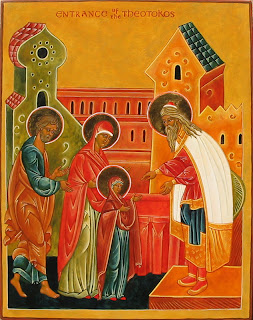
Presentation of the Blessed Virgin Mary


From a sermon by Saint Augustine

By faith she believed; by faith, conceived
Presentation of the Blessed Virgin Mary  
Stretching out his hand over his disciples, the Lord Christ declared: Here are my mother and my brothers; anyone who does the will of my Father who sent me is my brother and sister and my mother. I would urge you to ponder these words. Did the Virgin Mary, who believed by faith and conceived by faith, who was the chosen one from whom our Saviour was born among men, who was created by Christ before Christ was created in her – did she not do the will of the Father? Indeed the blessed Mary certainly did the Father’s will, and so it was for her a greater thing to have been Christ’s disciple than to have been his mother, and she was more blessed in her discipleship than in her motherhood. Hers was the happiness of first bearing in her womb him whom she would obey as her master.
  Now listen and see if the words of Scripture do not agree with what I have said. The Lord was passing by and crowds were following him. His miracles gave proof of divine power. and a woman cried out: Happy is the womb that bore you, blessed is that womb! But the Lord, not wishing people to seek happiness in a purely physical relationship, replied: More blessed are those who hear the word of God and keep it. Mary heard God’s word and kept it, and so she is blessed. She kept God’s truth in her mind, a nobler thing than carrying his body in her womb. The truth and the body were both Christ: he was kept in Mary’s mind insofar as he is truth, he was carried in her womb insofar as he is man; but what is kept in the mind is of a higher order than what is carried in the womb.
  The Virgin Mary is both holy and blessed, and yet the Church is greater than she. Mary is a part of the Church, a member of the Church, a holy, an eminent – the most eminent – member, but still only a member of the entire body. The body undoubtedly is greater than she, one of its members. This body has the Lord for its head, and head and body together make up the whole Christ. In other words, our head is divine – our head is God.
  Now, beloved, give me your whole attention, for you also are members of Christ; you also are the body of Christ. Consider how you yourselves can be among those of whom the Lord said: Here are my mother and my brothers. Do you wonder how you can be the mother of Christ? He himself said: Whoever hears and fulfils the will of my Father in heaven is my brother and my sister and my mother. As for our being the brothers and sisters of Christ, we can understand this because although there is only one inheritance and Christ is the only Son, his mercy would not allow him to remain alone. It was his wish that we too should be heirs of the Father, and co-heirs with himself.
  Now having said that all of you are brothers of Christ, shall I not dare to call you his mother? Much less would I dare to deny his own words. Tell me how Mary became the mother of Christ, if it was not by giving birth to the members of Christ? You, to whom I am speaking, are the members of Christ. Of whom were you born? “Of Mother Church,” I hear the reply of your hearts. You became sons of this mother at your baptism, you came to birth then as members of Christ. Now you in your turn must draw to the font of baptism as many as you possibly can. You became sons when you were born there yourselves, and now by bringing others to birth in the same way, you have it in your power to become the mothers of Christ.