From a discourse Against the Pagans by Saint Athanasius, bishop
The word of the Father gives order, direction and unity to creation
By his own wisdom and Word, who is our Lord and Saviour Christ, the all-holy Father (whose excellence far exceeds that of any creature), like a skilful steersman guides to safety all creation, regulating and keeping it in being, as he judges right. It is right that creation should exist as he has made it and as we see it happening, because this is his will, which no one would deny. For if the movement of the universe were irrational, and the world rolled on in random fashion, one would be justified in disbelieving what we say. But if the world is founded on reason, wisdom and science, and is filled with orderly beauty, then it must owe its origin and order to none other than the Word of God.
He is God, the living and creative God of the universe, the word of the good God, who is God in his own right. The Word is different from all created things: he is the unique Word belonging only to the good Father. This is the Word that created this whole world and enlightens it by his loving wisdom. He who is the good Word of the good Father produced the order in all creation, joining opposites together, and forming from them one harmonious sound. He is God, one and only-begotten, who proceeds in goodness from the Father as from the fountain of goodness, and gives order, direction and unity to creation.
By his eternal Word the Father created all things and implanted a nature in his creatures. He did not want to see them tossed about at the mercy of their own natures, and so be reduced to nothingness. But in his goodness he governs and sustains the whole of nature by his Word (who is himself also God), so that under the guidance, providence and ordering of that Word, the whole of nature might remain stable and coherent in his light. Nature was to share in the Father’s Word, whose reality is true, and be helped by him to exist, for without him it would cease to be. For unless the Word, who is the very “image of the invisible God, the firstborn of all creation,” kept it in existence it could not exist. For whatever exists, whether visible or invisible, remains in existence through him and in him, and he is also the head of the Church, as we are taught by the ministers of truth in their sacred writings.
The almighty and most holy Word of the Father pervades the whole of reality, everywhere unfolding his power and shining on all things visible and invisible. He sustains it all and binds it all together in himself. He leaves nothing devoid of his power but gives life and keeps it in being throughout all of creation and in each individual creature.
Wednesday, January 13, 2010

From the treatise Against Heresies by Saint Irenaeus, bishop
Knowledge of the Father
 consists in the self-revelation of the Son
No one can know the Father apart from God’s Word, that is, unless the Son reveals him, and no one can know the Son unless the Father so wills. Now the Son fulfils the Father’s good pleasure: the Father sends, the Son is sent, and he comes.
 The Father is beyond our sight and comprehension; but he is known by his Word, who tells us of him who surpasses all telling. In turn, the Father alone has knowledge of his Word. And the Lord has revealed both truths. Therefore, the Son reveals the knowledge of the Father by his revelation of himself. Knowledge of the Father consists in the self-revelation of the Son, for all is revealed through the Word.
The Father’s purpose in revealing the Son was to make himself known to us all and so to welcome into eternal rest those who believe in him, establishing them in justice, preserving them from death. To believe in him means to do his will.
Through creation itself the Word reveals God the Creator. Through the world he reveals the Lord who made the world. Through all that is fashioned he reveals the craftsman who fashioned it all. Through the Son the Word reveals the Father who begot him as Son. All speak of these things in the same language, but they do not believe them in the same way. Through the law and the prophets the Word revealed himself and his Father in the same way, and though all the people equally heard the message not all equally believed it. Through the Word, made visible and palpable, the Father was revealed, though not all equally believed in him. But all saw the Father in the Son, for the Father of the Son cannot be seen, but the Son of the Father can be seen. The Son performs everything as a ministry to the Father, from beginning to end, and without the Son no one can know God. The way to know the Father is the Son. Knowledge of the Son is in the Father, and is revealed through the Son. For this reason the Lord said: No one knows the Son except the Father; and no one knows the Father except the Son, and those to whom the Son has revealed him. The word “revealed” refers not only to the future – as though the Word began to reveal the Father only when he was born of Mary; it refers equally to all time. From the beginning the Son is present to creation, reveals the Father to all, to those the Father chooses, when the Father chooses, and as the Father chooses. So, there is in all and through all one God the Father, one Word and Son, and one Spirit, and one salvation for all who believe in him.
Tuesday, January 12, 2010
The ability to love is within each of us

From the Detailed Rules for Monks by St. Basil the Great, bishop
Love of God is not something that can be taught. We did not learn from someone else how to rejoice in light or want to live, or to love our parents or guardians. It is the same – perhaps even more so – with our love for God: it does not come by another’s teaching. As soon as the living creature (that is, man) comes to be, a power of reason is implanted in us like a seed, containing within it the ability and the need to love. When the school of God’s law admits this power of reason, it cultivates it diligently, skilfully nurtures it, and with God’s help brings it to perfection.
For this reason, as by God’s gift, I find you with the zeal necessary to attain this end, and you on your part help me with your prayers. I will try to fan into flame the spark of divine love that is hidden within you, as far as I am able through the power of the Holy Spirit.
First, let me say that we have already received from God the ability to fulfil all his commands. We have then no reason to resent them, as if something beyond our capacity were being asked of us. We have no reason either to be angry, as if we had to pay back more than we had received. When we use this ability in a right and fitting way, we lead a life of virtue and holiness. But if we misuse it, we fall into sin.
This is the definition of sin: the misuse of powers given us by God for doing good, a use contrary to God’s commands. On the other hand, the virtue that God asks of us is the use of the same powers based on a good conscience in accordance with God’s command.
Since this is so, we can say the same about love. Since we received a command to love God, we possess from the first moment of our existence an innate power and ability to love. The proof of this is not to be sought outside ourselves, but each one can learn this from himself and in himself. It is natural for us to want things that are good and pleasing to the eye, even though at first different things seem beautiful and good to different people. In the same way, we love what is related to us or near to us, though we have not been taught to do so, and we spontaneously feel well disposed to our benefactors.
What, I ask, is more wonderful than the beauty of God? What thought is more pleasing and wonderful than God’s majesty? What desire is as urgent and overpowering as the desire implanted by God in a soul that is completely purified of sin and cries out in its love: I am wounded by love? The radiance of divine beauty is altogether beyond the power of words to describe.
Love of God is not something that can be taught.
 We did not learn from someone else how to rejoice in light or want to live, or to love our parents or guardians. It is the same – perhaps even more so – with our love for God: it does not come by another’s teaching. As soon as the living creature (that is, man) comes to be, a power of reason is implanted in us like a seed, containing within it the ability and the need to love. When the school of God’s law admits this power of reason, it cultivates it diligently, skilfully nurtures it, and with God’s help brings it to perfection.
For this reason, as by God’s gift, I find you with the zeal necessary to attain this end, and you on your part help me with your prayers. I will try to fan into flame the spark of divine love that is hidden within you, as far as I am able through the power of the Holy Spirit.
First, let me say that we have already received from God the ability to fulfil all his commands. We have then no reason to resent them, as if something beyond our capacity were being asked of us. We have no reason either to be angry, as if we had to pay back more than we had received. When we use this ability in a right and fitting way, we lead a life of virtue and holiness. But if we misuse it, we fall into sin.
This is the definition of sin: the misuse of powers given us by God for doing good, a use contrary to God’s commands. On the other hand, the virtue that God asks of us is the use of the same powers based on a good conscience in accordance with God’s command.
Since this is so, we can say the same about love. Since we received a command to love God, we possess from the first moment of our existence an innate power and ability to love. The proof of this is not to be sought outside ourselves, but each one can learn this from himself and in himself. It is natural for us to want things that are good and pleasing to the eye, even though at first different things seem beautiful and good to different people. In the same way, we love what is related to us or near to us, though we have not been taught to do so, and we spontaneously feel well disposed to our benefactors.
What, I ask, is more wonderful than the beauty of God? What thought is more pleasing and wonderful than God’s majesty? What desire is as urgent and overpowering as the desire implanted by God in a soul that is completely purified of sin and cries out in its love: I am wounded by love? The radiance of divine beauty is altogether beyond the power of words to describe.
Monday, January 11, 2010
A letter of Pope St Clement I to the Corinthians

All wisdom comes from the Word of God on high
We shall pray without ceasing to the Creator of all things, and beg him to preserve the number of his elect throughout the whole world, through his beloved son Jesus Christ, and not let a single one of them fall away.
Through him you called us from darkness into light and gave us the knowledge of the glory of your name. He taught us to hope in you, from whom all creation has its being. He opened our eyes so that we would recognise you, most high among the highest, holy and surrounded by holiness. You put an end to the pride of the arrogant, you frustrate the plans of the gentiles, you raise up the lowly and bring down those who are exalted. You give riches and give poverty, you dispense both death and life. You succour every spirit, you are the God of all flesh. You behold what is hidden in the depths, you see all that men do. You give help to those in peril and rescue to those without hope. You create all that has breath and watch over it; you multiply the peoples of the earth, and from among them you choose those who love you through Jesus Christ your beloved Son, through whom you give us wisdom, holiness, and honour.
We beg you, Lord, to be our help and our support. Free us from our troubles; take pity on the lowly; raise up those who have fallen; give help to the poor, health to the sick, and bring home those who have wandered away. Feed the hungry, ransom captives, give strength to the weak and courage to the faint-hearted. Let all peoples come to know that you alone are God, that Jesus Christ is your son, and that we are your people and the sheep of your flock.
For by your acts you made visible the everlasting structure of the Universe and set the Earth on its foundations. For all generations you have been faithful and just in your judgements, and wonderful in your power and majesty. Wisely you have created, and wisely you have kept things in being. All that we see shows your goodness; to all who trust in you, you are faithful, kind, and merciful. Forgive us our wickednesses and injustices, our sins and our transgressions.
Do not weigh down your servants with the burden of their sins, but purify us and direct the paths we take so that we go forward in purity and innocence of heart, so that all that we do is good and acceptable to you and to those who lead us.
Come, Lord, let your face shine upon us so that we may peacefully enjoy all good things. May your powerful hand be a roof over our heads and may your strength preserve us from all wrongdoing. Free us, Lord, from those who hate us without cause. Give peace and harmony to us and to all the inhabitants of the Earth, as you gave them to our fathers who called on you with trust and faith.
You alone can give us these gifts and confer these favours on us. We put our trust in you through Jesus Christ, our high priest, the guardian of our souls. Through him be glory and majesty to you now and through all generations until the end of time. Amen.
We shall pray without ceasing to the Creator of all things, and beg him to preserve the number of his elect throughout the whole world, through his beloved son Jesus Christ, and not let a single one of them fall away.
Through him you called us from darkness into light and gave us the knowledge of the glory of your name. He taught us to hope in you, from whom all creation has its being. He opened our eyes so that we would recognise you, most high among the highest, holy and surrounded by holiness. You put an end to the pride of the arrogant, you frustrate the plans of the gentiles, you raise up the lowly and bring down those who are exalted. You give riches and give poverty, you dispense both death and life. You succour every spirit, you are the God of all flesh. You behold what is hidden in the depths, you see all that men do. You give help to those in peril and rescue to those without hope. You create all that has breath and watch over it; you multiply the peoples of the earth, and from among them you choose those who love you through Jesus Christ your beloved Son, through whom you give us wisdom, holiness, and honour.
We beg you, Lord, to be our help and our support. Free us from our troubles; take pity on the lowly; raise up those who have fallen; give help to the poor, health to the sick, and bring home those who have wandered away. Feed the hungry, ransom captives, give strength to the weak and courage to the faint-hearted. Let all peoples come to know that you alone are God, that Jesus Christ is your son, and that we are your people and the sheep of your flock.
For by your acts you made visible the everlasting structure of the Universe and set the Earth on its foundations. For all generations you have been faithful and just in your judgements, and wonderful in your power and majesty. Wisely you have created, and wisely you have kept things in being. All that we see shows your goodness; to all who trust in you, you are faithful, kind, and merciful. Forgive us our wickednesses and injustices, our sins and our transgressions.
Do not weigh down your servants with the burden of their sins, but purify us and direct the paths we take so that we go forward in purity and innocence of heart, so that all that we do is good and acceptable to you and to those who lead us.
Come, Lord, let your face shine upon us so that we may peacefully enjoy all good things. May your powerful hand be a roof over our heads and may your strength preserve us from all wrongdoing. Free us, Lord, from those who hate us without cause. Give peace and harmony to us and to all the inhabitants of the Earth, as you gave them to our fathers who called on you with trust and faith.
You alone can give us these gifts and confer these favours on us. We put our trust in you through Jesus Christ, our high priest, the guardian of our souls. Through him be glory and majesty to you now and through all generations until the end of time. Amen.
Saturday, January 9, 2010
A sermon by St Proclus of Constantinople
The waters are made holy
Christ appeared in the world, and, bringing beauty out of disarray, gave it lustre and joy. He bore the world’s sin and crushed the world’s enemy. He sanctified the fountains of waters and enlightened the minds of men. Into the fabric of miracles he interwove ever greater miracles.
For on this day land and sea share between them the grace of the Saviour, and the whole world is filled with joy. Today’s feast of the Epiphany manifests even more wonders than the feast of Christmas.
On the feast of the Saviour’s birth, the earth rejoiced because it bore the Lord in a manger; but on today’s feast of the Epiphany it is the sea that is glad and leaps for joy; the sea is glad because it receives the blessing of holiness in the river Jordan.
At Christmas we saw a weak baby, giving proof of our weakness. In today’s feast, we see a perfect man, hinting at the perfect Son who proceeds from the all-perfect Father. At Christmas the King puts on the royal robe of his body; at Epiphany the very source enfolds and, as it were, clothes the river.
Come then and see new and astounding miracles: the Sun of righteousness washing in the Jordan, fire immersed in water, God sanctified by the ministry of man.
Today every creature shouts in resounding song: Blessed is he who comes in the name of the Lord. Blessed is he who comes in every age, for this is not his first coming.
And who is he? Tell us more clearly, I beg you, blessed David: The Lord is God and has shone upon us. David is not alone in prophesying this; the apostle Paul adds his own witness, saying: The grace of God has appeared bringing salvation for all men, and instructing us. Not for some men, but for all. To Jews and Greeks alike God bestows salvation through baptism, offering baptism as a common grace for all.
Come, consider this new and wonderful deluge, greater and more important than the flood of Noah’s day. Then the water of the flood destroyed the human race, but now the water of baptism has recalled the dead to life by the power of the one who was baptised. In the days of the flood the dove with an olive branch in its beak foreshadowed the fragrance of the good odour of Christ the Lord; now the Holy Spirit, coming in the likeness of a dove, reveals the Lord of mercy.
Christ appeared in the world, and, bringing beauty out of disarray, gave it lustre and joy. He bore the world’s sin and crushed the world’s enemy. He sanctified the fountains of waters and enlightened the minds of men. Into the fabric of miracles he interwove ever greater miracles.
For on this day land and sea share between them the grace of the Saviour,
 and the whole world is filled with joy. Today’s feast of the Epiphany manifests even more wonders than the feast of Christmas.
On the feast of the Saviour’s birth, the earth rejoiced because it bore the Lord in a manger; but on today’s feast of the Epiphany it is the sea that is glad and leaps for joy; the sea is glad because it receives the blessing of holiness in the river Jordan.
At Christmas we saw a weak baby, giving proof of our weakness. In today’s feast, we see a perfect man, hinting at the perfect Son who proceeds from the all-perfect Father. At Christmas the King puts on the royal robe of his body; at Epiphany the very source enfolds and, as it were, clothes the river.
Come then and see new and astounding miracles: the Sun of righteousness washing in the Jordan, fire immersed in water, God sanctified by the ministry of man.
Today every creature shouts in resounding song: Blessed is he who comes in the name of the Lord. Blessed is he who comes in every age, for this is not his first coming.
And who is he? Tell us more clearly, I beg you, blessed David: The Lord is God and has shone upon us. David is not alone in prophesying this; the apostle Paul adds his own witness, saying: The grace of God has appeared bringing salvation for all men, and instructing us. Not for some men, but for all. To Jews and Greeks alike God bestows salvation through baptism, offering baptism as a common grace for all.
Come, consider this new and wonderful deluge, greater and more important than the flood of Noah’s day. Then the water of the flood destroyed the human race, but now the water of baptism has recalled the dead to life by the power of the one who was baptised. In the days of the flood the dove with an olive branch in its beak foreshadowed the fragrance of the good odour of Christ the Lord; now the Holy Spirit, coming in the likeness of a dove, reveals the Lord of mercy.
Friday, January 8, 2010
WATER AND THE SPIRIT
A discourse on the Theophany by pseudo- Hippolytus
Water and the Spirit
That Jesus should come and be baptized by John is surely cause for amazement. To think of the infinite river that gladdens the city of God being bathed in a poor little stream; of the eternal and unfathomable fountainhead that gives life to all men being immersed in the shallow waters of this transient world!
He who fills all creation, leaving no place devoid of his presence, he who is incomprehensible to the angels and hidden from the sight of man, came to be baptized because it was his will. And behold, the heavens opened and a voice said: This is my beloved Son in whom I am well pleased.
The beloved Father begets love, and the immaterial Light generates light inaccessible. This is he who was called the son of Joseph and in his divine nature is my only Son.
This is my beloved Son. Though hungry himself, he feeds thousands; though weary, he refreshes those who labour. He has no place to lay his head yet he holds all creation in his hand. By his suffering he heals all sufferings; by receiving a blow on the cheek he gives the world its liberty; by being pierced in the side he heals the wound in Adam’s side.
And now, please pay close attention, for I want to return to that fountain of life and contemplate its healing waters as they gush out.
The Father of immortality sent his immortal Son and Word into the world, to come to us men and cleanse us with water and the Spirit. To give us a new birth that would make our bodies and souls immortal, he breathed into us the spirit of life and armed us with incorruptibility. Now if we become immortal, we shall also be divine; and if we become divine after rebirth in baptism through water and the Holy Spirit, we shall also be heirs along with Christ, after the resurrection of the dead.
So I cry out, like a herald: Let peoples of every nation come and receive the immortality that flows from baptism. This is the water that is linked to the Spirit, the water that irrigates Paradise, makes the earth fertile, gives growth to plants, and brings forth living creatures. In short, this is the water by which a man receives new birth and life, the water in which even Christ was baptized, the water into which the Holy Spirit descended in the form of a dove.
Whoever goes down into these waters of rebirth with faith renounces the devil and pledges himself to Christ. He repudiates the enemy and confesses that Christ is God, throws off his servitude and becomes an adopted son. He comes up from baptism resplendent as the sun and radiating purity and, above all, he comes as a son of God and a co-heir with Christ.
To him be glory and power, to him and his most holy, good and life-giving Spirit, both now and for ever. Amen.
Read Luke 4:14 to learn more about John the Baptist and the Baptism of Jesus. It is with great interest to note that while John was in the 'desert' God spoke to him. It is the same message even today. The desert also symbolizes silence and solitude and it is only in that still ness that we can hear God speak. "Be still before the Lord".
Water and the Spirit
That Jesus should come and be baptized by John is surely cause for amazement. To think of the infinite river that gladdens the city of God being bathed in a poor little stream; of the eternal and unfathomable fountainhead that gives life to all men being immersed in the shallow waters of this transient world!
He who fills all creation, leaving no place devoid of his presence, he who is incomprehensible to the angels and hidden from the sight of man, came to be baptized because it was his will. And behold, the heavens opened and a voice said: This is my beloved Son in whom I am well pleased.
The beloved Father begets love, and the immaterial Light generates light inaccessible. This is he who was called the son of Joseph and in his divine nature is my only Son.
This is my beloved Son. Though hungry himself, he feeds thousands; though weary, he refreshes those who labour. He has no place to lay his head yet he holds all creation in his hand. By his suffering he heals all sufferings; by receiving a blow on the cheek he gives the world its liberty; by being pierced in the side he heals the wound in Adam’s side.
And now, please pay close attention, for I want to return to that fountain of life and contemplate its healing waters as they gush out.
The Father of immortality sent his immortal Son and Word into the world, to come to us men and cleanse us with water and the Spirit. To give us a new birth that would make our bodies and souls immortal, he breathed into us the spirit of life and armed us with incorruptibility. Now if we become immortal, we shall also be divine; and if we become divine after rebirth in baptism through water and the Holy Spirit, we shall also be heirs along with Christ, after the resurrection of the dead.
So I cry out, like a herald: Let peoples of every nation come and receive the immortality that flows from baptism. This is the water that is linked to the Spirit, the water that irrigates Paradise, makes the earth fertile, gives growth to plants, and brings forth living creatures. In short, this is the water by which a man receives new birth and life, the water in which even Christ was baptized, the water into which the Holy Spirit descended in the form of a dove.
Whoever goes down into these waters of rebirth with faith renounces the devil and pledges himself to Christ. He repudiates the enemy and confesses that Christ is God, throws off his servitude and becomes an adopted son. He comes up from baptism resplendent as the sun and radiating purity and, above all, he comes as a son of God and a co-heir with Christ.
To him be glory and power, to him and his most holy, good and life-giving Spirit, both now and for ever. Amen.
Read Luke 4:14 to learn more about John the Baptist and the Baptism of Jesus. It is with great interest to note that while John was in the 'desert' God spoke to him. It is the same message even today. The desert also symbolizes silence and solitude and it is only in that still ness that we can hear God speak. "Be still before the Lord".
Monday, January 4, 2010
inside andoutside the hermitage walls
First I will start with a few patients. Many had malaria and other wounds. Remember, they need your help...Please donate by clicking on the paypal button or sending to Bob shrigley

 These are just for wounds....what a group
 One boy with Malaria
 Girl with wound on top of foot
 More wounds
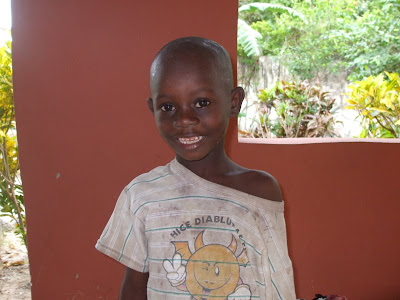 Is he a happy child??
 Wounded leg

 Broken Shoulder
What beautiful eyes,,,this boys name is Alfa and his father is a Koranic scholar.
Some folks have asked what the hermitage looked like from the other side of the wall. I usually walk the paths saying my rosary of Divine Mercy chaplet so here are a few pictures.
Bamboo in front of hermitage gate

Front Gate

Junction at side of the hermitage

Growing Casava across the road

Main road by the hermitage gate

My walking road to Madiana, a nearby village

Hansel and Gretel, the two great hermitage dogs and Lausan (Barbara Masser's schoolboy)

 These are just for wounds....what a group
 One boy with Malaria
  Girl with wound on top of foot
 More wounds
 Is he a happy child??
 Wounded leg
 Broken Shoulder
What beautiful eyes,,,this boys name is Alfa and his father is a Koranic scholar.
Some folks have asked what the hermitage looked like from the other side of the wall. I usually walk the paths saying my rosary of Divine Mercy chaplet so here are a few pictures.
Bamboo in front of hermitage gate

Front Gate

Junction at side of the hermitage

Growing Casava across the road

Main road by the hermitage gate

My walking road to Madiana, a nearby village

Hansel and Gretel, the two great hermitage dogs and Lausan (Barbara Masser's schoolboy)
I hope you liked these pictures. I didn't want to put any gruesome ones with terrible wounds as it might not go over too well.
God bles you and please help!
Brother dismas Mary of the cross,
A Penitent hermit of Divine Mercy
Thursday, December 31, 2009
January 1, 2010- Feast of Mary, Mother of God
Let us celebrate the motherhood of the Virgin Mary, and let us worship Christ the Lord, her Son.
Second reading from the office of readings; A letter of St Athanasius
 The Word took our nature from Mary
The Word took to himself the sons of Abraham, says the Apostle, and so had to be like his brothers in all things. He had then to take a body like ours. This explains the fact of Mary’s presence: she is to provide him with a body of his own, to be offered for our sake. Scripture records her giving birth, and says: She wrapped him in swaddling clothes. Her breasts, which fed him, were called blessed. Sacrifice was offered because the child was her firstborn. Gabriel used careful and prudent language when he announced his birth. He did not speak of “what will be born in you” to avoid the impression that a body would be introduced into her womb from outside; he spoke of “what will be born from you,” so that we might know by faith that her child originated within her and from her.
By taking our nature and offering it in sacrifice, the Word was to destroy it completely and then invest it with his own nature, and so prompt the Apostle to say: This corruptible body must put on incorruption; this mortal body must put on immortality.
This was not done in outward show only, as some have imagined. This is not so. Our Saviour truly became man, and from this has followed the salvation of man as a whole. Our salvation is in no way fictitious, nor does it apply only to the body. The salvation of the whole man, that is, of soul and body, has really been achieved in the Word himself.
What was born of Mary was therefore human by nature, in accordance with the inspired Scriptures, and the body of the Lord was a true body: It was a true body because it was the same as ours. Mary, you see, is our sister, for we are all born from Adam.
The words of St John, the Word was made flesh, bear the same meaning, as we may see from a similar turn of phrase in St Paul: Christ was made a curse for our sake. Man’s body has acquired something great through its communion and union with the Word. From being mortal it has been made immortal; though it was a living body it has become a spiritual one; though it was made from the earth it has passed through the gates of heaven.
Even when the Word takes a body from Mary, the Trinity remains a Trinity, with neither increase nor decrease. It is for ever perfect. In the Trinity we acknowledge one Godhead, and thus one God, the Father of the Word, is proclaimed in the Church
 The Word took our nature from Mary
The Word took to himself the sons of Abraham, says the Apostle, and so had to be like his brothers in all things. He had then to take a body like ours. This explains the fact of Mary’s presence: she is to provide him with a body of his own, to be offered for our sake. Scripture records her giving birth, and says: She wrapped him in swaddling clothes. Her breasts, which fed him, were called blessed. Sacrifice was offered because the child was her firstborn. Gabriel used careful and prudent language when he announced his birth. He did not speak of “what will be born in you” to avoid the impression that a body would be introduced into her womb from outside; he spoke of “what will be born from you,” so that we might know by faith that her child originated within her and from her.
By taking our nature and offering it in sacrifice, the Word was to destroy it completely and then invest it with his own nature, and so prompt the Apostle to say: This corruptible body must put on incorruption; this mortal body must put on immortality.
This was not done in outward show only, as some have imagined. This is not so. Our Saviour truly became man, and from this has followed the salvation of man as a whole. Our salvation is in no way fictitious, nor does it apply only to the body. The salvation of the whole man, that is, of soul and body, has really been achieved in the Word himself.
What was born of Mary was therefore human by nature, in accordance with the inspired Scriptures, and the body of the Lord was a true body: It was a true body because it was the same as ours. Mary, you see, is our sister, for we are all born from Adam.
The words of St John, the Word was made flesh, bear the same meaning, as we may see from a similar turn of phrase in St Paul: Christ was made a curse for our sake. Man’s body has acquired something great through its communion and union with the Word. From being mortal it has been made immortal; though it was a living body it has become a spiritual one; though it was made from the earth it has passed through the gates of heaven.
Even when the Word takes a body from Mary, the Trinity remains a Trinity, with neither increase nor decrease. It is for ever perfect. In the Trinity we acknowledge one Godhead, and thus one God, the Father of the Word, is proclaimed in the Church
Wednesday, December 30, 2009
7th day within the Octave of Christmas
Happy New Year and God's peace to you all!!
A sermon of Pope St Leo the Great
The birthday of the Lord is the birthday of peace
God’s Son did not disdain to become a baby. Although with the passing of the years he moved from infancy to maturity, and although with the triumph of his passion and resurrection all the actions of humility which he undertook for us were finished, still today’s festival renews for us the holy childhood of Jesus born of the Virgin Mary. In adoring the birth of our Saviour, we find we are celebrating the commencement of our own life, for the birth of Christ is the source of life for Christian folk, and the birthday of the Head is the birthday of the body.
Every individual that is called has his own place, and all the sons of the Church are separated from one another by intervals of time. Nevertheless, just as the entire body of the faithful is born in the font of baptism, crucified with Christ in his passion, raised again in his resurrection, and placed at the Father’s right hand in his ascension, so with Him are they born in this nativity.
For this is true of any believer in whatever part of the world, that once he is reborn in Christ he abandons the old paths of his original nature and passes into a new man by being reborn. He is no longer counted as part of his earthly father’s stock but among the seed of the Saviour, who became the Son of man in order that we might have the power to be the sons of God.
For unless He came down to us in this humiliation, no one could reach his presence by any merits of his own.
The very greatness of the gift conferred demands of us reverence worthy of its splendour. For, as the blessed Apostle teaches, We have received not the spirit of this world but the Spirit which is of God, that we may know the things which are given us by God. That Spirit can in no other way be rightly worshipped, except by offering him that which we received from him.
But in the treasures of the Lord’s bounty what can we find so suitable to the honour of the present feast as the peace which at the Lord’s nativity was first proclaimed by the angel-choir?
For it is that peace which brings forth the sons of God. That peace is the nurse of love and the mother of unity, the rest of the blessed and our eternal home. That peace has the special task of joining to God those whom it removes from the world.
So those who are born not of blood nor of the will of the flesh nor of the will of man but of God must offer to the Father the unanimity of peace-loving sons, and all of them, adopted parts of the mystical Body of Christ, must meet in the First-begotten of the new creation. He came to do not his own will but the will of the one who sent him; and so too the Father in his gracious favour has adopted as his heirs not those that are discordant nor those that are unlike him, but those that are one with him in feeling and in affection. Those who are re-modelled after one pattern must have a spirit like the model.
The birthday of the Lord is the birthday of peace: for thus says the Apostle, He is our peace, who made both one; because whether we are Jew or Gentile, through Him we have access in one Spirit to the Father.
A sermon of Pope St Leo the Great
The birthday of the Lord is the birthday of peace
God’s Son did not disdain to become a baby. Although with the passing of the years he moved from infancy to maturity, and although with the triumph of his passion and resurrection all the actions of humility which he undertook for us were finished, still today’s festival renews for us the holy childhood of Jesus born of the Virgin Mary. In adoring the birth of our Saviour, we find we are celebrating the commencement of our own life, for the birth of Christ is the source of life for Christian folk, and the birthday of the Head is the birthday of the body.
Every individual that is called has his own place, and all the sons of the Church are separated from one another by intervals of time. Nevertheless, just as the entire body of the faithful is born in the font of baptism, crucified with Christ in his passion, raised again in his resurrection, and placed at the Father’s right hand in his ascension, so with Him are they born in this nativity.
For this is true of any believer in whatever part of the world, that once he is reborn in Christ he abandons the old paths of his original nature and passes into a new man by being reborn. He is no longer counted as part of his earthly father’s stock but among the seed of the Saviour, who became the Son of man in order that we might have the power to be the sons of God.
For unless He came down to us in this humiliation, no one could reach his presence by any merits of his own.
The very greatness of the gift conferred demands of us reverence worthy of its splendour. For, as the blessed Apostle teaches, We have received not the spirit of this world but the Spirit which is of God, that we may know the things which are given us by God. That Spirit can in no other way be rightly worshipped, except by offering him that which we received from him.
But in the treasures of the Lord’s bounty what can we find so suitable to the honour of the present feast as the peace which at the Lord’s nativity was first proclaimed by the angel-choir?
For it is that peace which brings forth the sons of God. That peace is the nurse of love and the mother of unity, the rest of the blessed and our eternal home. That peace has the special task of joining to God those whom it removes from the world.
So those who are born not of blood nor of the will of the flesh nor of the will of man but of God must offer to the Father the unanimity of peace-loving sons, and all of them, adopted parts of the mystical Body of Christ, must meet in the First-begotten of the new creation. He came to do not his own will but the will of the one who sent him; and so too the Father in his gracious favour has adopted as his heirs not those that are discordant nor those that are unlike him, but those that are one with him in feeling and in affection. Those who are re-modelled after one pattern must have a spirit like the model.
The birthday of the Lord is the birthday of peace: for thus says the Apostle, He is our peace, who made both one; because whether we are Jew or Gentile, through Him we have access in one Spirit to the Father.
Wednesday, December 23, 2009
Consecration and solemn profession December 13, Holy Family Church,Bakau, The Gambia
December 13, 2009......Holy Family church, Bakau, The Gambia
Afterthe Bishop delivered the homilyamd returned to his seat,,he called me to come foward. "What do you ask of God and the Church" I answered that "with all my being I ask to be consecrated as a canonical hermit and to solemly profess profess the evangelical counsels plus a fourth vow to pray for Clergy,religious Hermits and Consecrated Virgins throughout the world, but mostespecially in this diocese.

Then he asked further questions and instructed me face the community and pronounce my solemn profession to the church. With my right hand on the scripture I made my profession.
 With my right hand on the scripture I made my profession.
I then signed my solems vows at the altar.
This was followed by the blessing of my scalular, profession cross and choir mantle

Then The scapular was placed over my tunic and cincture

Then I received my profession cross


.
Then came m the time for the choir mantle to be placed onto Brother Dismas Mary of the Cross

Kiss of Peace from the Bishop
Then came
 m the time for the choir mantle to be placed onto Brother Dismas Mary of the Cross
Kiss of Peace from the Bishop

Kiss Peace From Fr. Tony Sonko, My Spiritual Director

Kiss of Peace from Father Peter Jammeh, Assistant Pastor

The ceremony has ended and the Liturgy of the Eucharist begins. I received the bread and wine and went to my pew to pray for all my family, friends, benefactors...especially my Brother Jackie and my sister Peggy and my Mom and grandmother who have passed away. I prayed for my Children, Meg, Maureen and Katie and all my grandchildren.
God bless everyone for your support and prayer for this momentous day. Pray for me as I will for you
Brother Dismas Mary of the Cross
A Penitent Hermit of Divine Mercy for the Diocese of Banjul, The Gambia
Saturday, December 19, 2009
Temporary fix
If you would like to see the consecration pictures, go the the below web site and you can view them. Thanks for your patience.....
http://home.comcast.net/~pbcousineau/Dismas/index.htm
http://home.comcast.net/~pbcousineau/Dismas/index.htm
Friday, December 18, 2009
sorry my friends
I am having all sorts of technical problems with getting the consecration pictures on this blog and cant figure out why. All my other pictures come out just fine. I have a cousing hekping but now I am going to call the photographer and ask him to send as attachments and see if he can make them smaller. Say a prayer!!
God bless you all
dismas
God bless you all
dismas
Thursday, December 3, 2009
Forgive me!!
Dear friends,
I am preparing to be consecrated as a Canonical hermit and profess my solemn perpetual vows on the 13th of December. I will be on retreat from 10 December until the Consecration.
From today up to the consecration I am pretty busy with all sorts of practical preparations and with things other things to to do and will be unable to post anything on the blog until after the 13th of December. Please excuse my being away from the blog during this time and I ask you all to pray for me.
In the meantime, if anyone feels led by the Spirit to donate, please feel free to do so. Once again, I am completely out of Malaria Medicines and am so desperate to obtain some. They can only be purchased here so financial contributions will be cery helpful.
I have begun to turn patients away as of today because of the lack of proper meds.. Please, your help would be so gratefully appreciated.
I have lots more pictures of patients and the hermitage all set to post but they will also have to wait until after the 13th.
God bless your kindness.
In His Divine Mercy
dismas
Thursday, November 26, 2009
| A homily by St John Chrysostom | |
|---|---|
| If we are sheep, we overcome; if wolves, we are overcome | |
As long as we are sheep, we overcome and, though surrounded by countless wolves, we emerge victorious; but if we turn into wolves, we are overcome, for we love the shepherd’s help. He, after all, feeds the sheep not wolves, and will abandon you if you do not let him show his power in you. What he says is this: “Do not be upset that, as I send you out among the wolves, I bid you be as sheep and doves. I could have managed things quite differently and sent you, not to suffer evil nor to yield like sheep to the wolves, but to be fiercer than lions. But the way I have chosen is right. It will bring you greater praise and at the same time manifest my power.” That is what he told Paul: My grace is enough for you, for in weakness my power is made perfect. “I intend,” he says, “to deal in the same way with you.” For, when he says, I am sending you out like sheep, he implies: “But do not therefore lose heart, for I know and am certain that no one will be able to overcome you.” The Lord, however, does want them to contribute something, lest everything seem to be the work of grace, and they seem to win their reward without deserving it. Therefore he adds: You must be clever as snakes and innocent as doves. But, they may object, what good is our cleverness amid so many dangers? How can we be clever when tossed about by so many waves? However great the cleverness of the sheep as he stands among the wolves – so many wolves! – what can it accomplish?However great the innocence of the dove, what good does it do him,with so many hawks swooping upon him? To all this I say: Cleverness and innocence admittedly do these irrational creatures no good, but they can help you greatly. What cleverness is the Lord requiring here? The cleverness of a snake. A snake will surrender everything and will put up no great resistance even if its body is being cut in pieces, provided it can save its head. So you, the Lord is saying, must surrender everything but your faith: money, body, even life itself. For faith is the head and the root; keep that, and though you lose all else, you will get it back in abundance. The Lord therefore counselled the disciples to be not simply clever or innocent; rather he joined the two qualities so that they become a genuine virtue. He insisted on the cleverness of the snake so that deadly wounds might be avoided, and he insisted on the innocence of the dove so that revenge might not be taken on those who injure or lay traps for you. Cleverness is useless without innocence. Do not believe that this precept is beyond your power. More than anyone else, the Lord knows the true natures of created things; he knows that moderation, not a fierce defence, beats back a fierce attack. | |
Tuesday, November 24, 2009
Saints Andrew Dung-Lac and his Companions
The evangelization of Vietnam  began in the 16th century and was formally established with the setting up of two Vicariates Apostolic in 1659. There are now about 6 million Catholics in Vietnam, some 10% of the population.
This growth comes partly from the fact that since the earliest times the seed of the Faith has been watered by the blood of the martyrs of Vietnam – the missionary clergy, the local clergy and the ordinary Christian people. They have all shared the labour of apostolic work and have together faced death to bear witness to the truth of the Gospel. In the course of the 17th, 18th and 19th centuries no less than 53 decrees, signed by the lords and emperors of the country from 1625 to 1886, launched one persecution of Christians after another, each one more savage than the last. Over the whole territory of Vietnam about 130,000 Christians were killed in these persecutions. Over the centuries the names of most of them have been lost, but their memory is still alive in the Catholic community.
Since the beginning of the 20th century 117 of these heroes (those whose sufferings were cruellest and best documented) were beatified, in four groups. They were all canonized together by Pope John Paul II on 19 June 1988.
Each one of them was a soul individually created and loved by God, with a life and gifts uniquely his or her own; but with such a huge crowd one can only classify. By nationality, there were 96 Vietnamese, 11 Spanish and 10 French. By status, there were 8 bishops, 50 priests, and 59 laymen and women. By mode of death, 75 were beheaded, 22 strangled, 6 burned alive, 5 torn to pieces while still alive, and 9 died of torture in prison.
began in the 16th century and was formally established with the setting up of two Vicariates Apostolic in 1659. There are now about 6 million Catholics in Vietnam, some 10% of the population.This growth comes partly from the fact that since the earliest times the seed of the Faith has been watered by the blood of the martyrs of Vietnam – the missionary clergy, the local clergy and the ordinary Christian people. They have all shared the labour of apostolic work and have together faced death to bear witness to the truth of the Gospel. In the course of the 17th, 18th and 19th centuries no less than 53 decrees, signed by the lords and emperors of the country from 1625 to 1886, launched one persecution of Christians after another, each one more savage than the last. Over the whole territory of Vietnam about 130,000 Christians were killed in these persecutions. Over the centuries the names of most of them have been lost, but their memory is still alive in the Catholic community.
Since the beginning of the 20th century 117 of these heroes (those whose sufferings were cruellest and best documented) were beatified, in four groups. They were all canonized together by Pope John Paul II on 19 June 1988.
Each one of them was a soul individually created and loved by God, with a life and gifts uniquely his or her own; but with such a huge crowd one can only classify. By nationality, there were 96 Vietnamese, 11 Spanish and 10 French. By status, there were 8 bishops, 50 priests, and 59 laymen and women. By mode of death, 75 were beheaded, 22 strangled, 6 burned alive, 5 torn to pieces while still alive, and 9 died of torture in prison.
| A treatise of St Augustine on St John's gospel | |
|---|---|
| You will come to the spring and see light itself | |
We Christians are the light, at least by comparison with unbelievers. Thus the Apostle says: Once you were darkness, but now you are light in the Lord; walk then as sons of the light. And elsewhere he says: The night is far spent, the day is drawing near. Let us therefore lay aside the works of darkness and put on the armour of light; let us walk uprightly as in the day. Nevertheless, since the days in which we are now living are still dark compared to the light which we shall see, hear what the apostle Peter says. He speaks of a voice that came from the Supreme Glory and said to the Lord Jesus Christ: You are my beloved Son in whom I am well pleased. This voice, he says, we heard coming from heaven, when we were with him on the holy mountain. Because we ourselves were not present there and did not hear that voice from heaven, Peter says to us:And we possess a more certain prophetic word to which you do well to attend, as to a lamp shining in a dark place, until the day dawns and the morning star rises in your hearts. When, therefore, our Lord Jesus Christ comes and, as the apostle Paul says, brings to light things hidden in darkness and makes plain the secrets of the heart, so that everyone may receive his commendation from God, then lamps will no longer be needed. When that day is at hand, the prophet will not be read to us, the book of the Apostle will not be opened, we shall not require the testimony of John, we shall have no need of the Gospel itself. Therefore all Scriptures will be taken away from us, those Scriptures which in the night of this world burned like lamps so that we might not remain in darkness. When all these things are removed as no longer necessary for our illumination, and when the men of God by whom they were ministered to us shall themselves together with us behold the true and dear light without such aids, what shall we see? With what shall our minds be nourished? What will give joy to our gaze? Where will that gladness come from, which eye has not seen, and ear has not heard, which has not even been conceived by the heart of man? What shall we see? I implore you to love with me and, by believing, to run with me; let us long for our heavenly country, let us sigh for our heavenly home, let us truly feel that here we are strangers. What shall we then see? Let the gospel tell us: In the beginning was the Word and the Word was with God and the Word was God. You will come to the fountain, with whose dew you have already been sprinkled. Instead of the ray of light which was sent through slanting and winding ways into the heart of your darkness, you will see the light itself in all its purity and brightness. It is to see and experience this light that you are now being cleansed. Dearly beloved, John himself says, we are the sons of God, and it has not yet been disclosed what we shall be; but we know that when he appears we shall be like him, because we shall see him as he is. I feel that your spirits are being raised up with mine to the heavens above; but the body which is corruptible weighs down the soul, and this earthly tent burdens the thoughtful mind. I am about to lay aside this book, and you are soon going away, each to his own business. It has been good for us to share the common light, good to have enjoyed ourselves, good to have been glad together. When we part from one another, let us not depart from him. | |
Wednesday, November 18, 2009
A sermon by St Augustine

| The heart of the just man will rejoice in the Lord | |
|---|---|
The just man will rejoice in the Lord and put his hope in him; the hearts of all good men will be filled with joy. We must surely have sung these words with our hearts as well as with our voices. Indeed, the tongue of the Christian expresses his deepest feelings when it addresses such words to God. The just man will rejoice, not in the world, but in the Lord. Light has dawned for the just, Scripture says in another place, and joy for the upright of heart. Were you wondering what reason he has for joy? Here you are told: The just man will rejoice in the Lord. Another text runs: Delight in the Lord, and he will give you your heart’s desires. What are we instructed to do then, and what are we enabled to do? To rejoice in the Lord. But who can rejoice in something he does not see? Am I suggesting that we see the Lord then? No, but we have been promised that we shall see him. Now, as long as we are in the body, we walk by faith, for we are absent from the Lord. We walk by faith, and not by sight. When will it be by sight? Beloved, says John, we are now the sons of God; what we shall be has not yet been revealed, but we know that when it is revealed we shall be like him, because we shall see him as he is. When this prophecy is fulfilled, then it will be by sight. That will be the great joy, the supreme joy, joy in all its fullness. Then we shall no longer drink the milk of hope, but we shall feed on the reality itself. Nevertheless, even now, before that vision comes to us, or before we come to that vision, let us rejoice in the Lord; for it is no small reason for rejoicing to have a hope that will some day be fulfilled. Therefore, since the hope we now have inspires love, the just man rejoices, Scripture says, in the Lord; but because he does not yet see, it immediately goes on to say, and hopes in him. Yet already we have the first fruits of the Spirit, and have we not also other reasons for rejoicing? For we are drawing near to the one we love, and not only are we drawing near – we even have some slight feeling and taste of the banquet we shall one day eagerly eat and drink. But how can we rejoice in the Lord if he is far from us? Pray God he may not be far. If he is, that is your doing. Love, and he will draw near; love, and he will dwell within you. The Lord is at hand; have no anxiety. Are you puzzled to know how it is that he will be with you if you love? God is love. “What do you mean by love?” you will ask me. It is that which enables us to be loving. What do we love? A good that words cannot describe, a good that is for ever giving, a good that is the Creator of all good. Delight in him from whom you have received everything that delights you. But in that I do not include sin, for sin is the one thing that you do not receive from him. With that one exception, everything you have comes from him | |
Monday, November 16, 2009
St. Gertrude and St. Margaret of Scotland
The treatise of St Fulgentius of Ruspe on the forgiveness | |
|---|---|
| Whoever conquers will not be harmed by the second death | |
In a moment, in the twinkling of an eye as the final trumpet sounds, for the trumpet shall indeed sound, the dead shall rise incorruptible and we shall be changed. In saying “we,” Paul is indicating that the gift of that future change will also be given to those who during their time on earth are united to him and his companions by upright lives within the communion of the Church. He hints at the nature of the change when he says: This corruptible body must put on incorruptibility, this mortal body immortality. In order, then, that men may obtain the transformation which is the reward of the just, they must first undergo here on earth a change which is God’s free gift. Those who in this life have been changed from evil to good are promised that future change as a reward. Through justification and the spiritual resurrection, grace now effects in them an initial change that is God’s gift. Later on, through the bodily resurrection, the transformation of the just will be brought to completion, and they will experience a perfect, abiding, unchangeable glorification. The purpose of this change wrought in them by the gifts of both justification and glorification is that they may abide in an eternal, changeless state of joy. Here on earth they are changed by the first resurrection, in which they are enlightened and converted, thus passing from death to life, sinfulness to holiness, unbelief to faith, and evil actions to holy life. For this reason the second death has no power over them. It is of such men that the Book of Revelation says: Happy the man who shares in the first resurrection; over such as he the second death has no power. Elsewhere the same book says: He who overcomes shall not be harmed by the second death. As the first resurrection consists of the conversion of the heart, the second death consists of unending torment. Let everyone, therefore, who does not wish to be condemned to the endless punishment of the second death now hasten to share in the first resurrection. For if any during this life are changed out of fear of God and pass from an evil life to a good one, they pass from death to life and later they shall be transformed from a shameful state to a glorious one. | |
 She was born in Hungary of Anglo-Saxon and Hungarian parents. When William of Normandy conquered England she found refuge with King Malcolm III of Scotland, and they were married in 1070 and had eight children. She reformed the royal court, founded monasteries, and supported major reforms of Church life. She died in Edinburgh on 16 November 1093. She is remembered for the happiness of her marriage, for her devotion to prayer and learning, and especially for her generosity to the poor.
 She was born at Eisleben in Thuringia. As a girl she was educated by the Benedictine nuns at Helfta and was particularly talented at literature and philosophy. She turned to God and became a nun herself. She was devoted to the mystery of the Incarnation, in particular to the Sacred Heart of Jesus and to the Eucharist. She the recipient of many mystical experiences, and her spiritual writings had great influence in later centuries and indirectly contributed to the establishment of the feast of the Sacred Hear
Saturday, November 14, 2009
Readings from the Book of Wisdom
First reading from Friday's mass | Wisdom 13:1-9 © | ||||
|---|---|---|---|---|---|
Naturally stupid are all men who have not known God and who, from the good things that are seen, have not been able to discover Him-who-is, or, by studying the works, have failed to recognise the Artificer. Fire however, or wind, or the swift air, the sphere of the stars, impetuous water, heaven’s lamps, are what they have held to be the gods who govern the world. If, charmed by their beauty, they have taken things for gods, let them know how much the Lord of these excels them, since the very Author of beauty has created them. And if they have been impressed by their power and energy, let them deduce from these how much mightier is he that has formed them, since through the grandeur and beauty of the creatures we may, by analogy, contemplate their Author. Small blame, however, attaches to these men, for perhaps they only go astray in their search for God and their eagerness to find him; living among his works, they strive to comprehend them and fall victim to appearances, seeing so much beauty. Even so, they are not to be excused: if they are capable of acquiring enough knowledge to be able to investigate the world, how have they been so slow to find its Master First Reading from Saturday's mass
| |||||
Thursday, November 12, 2009
St. Joshaphat
| Pope Pius XI's encyclical "Ecclesiam Dei" | |
|---|---|
He gave his life for  the unity of the Church the unity of the Church | |
In designing his Church God worked with such skill that in the fullness of time it would resemble a single great family embracing all men. It can be identified, as we know, by certain distinctive characteristics, notably its universality and unity. Christ the Lord passed on to his apostles the task he had received from the Father: I have been given all authority in heaven and on earth. Go, therefore, and make disciples of all nations. He wanted the apostles as a body to be intimately bound together, first by the inner tie of the same faith and love which flows into our hearts through the Holy Spirit, and, second, by the external tie of authority exercised by one apostle over the others. For this he assigned the primacy to Peter, the source and visible basis of their unity for all time. So that the unity and agreement among them would endure, God wisely stamped them, one might say, with the mark of holiness and martyrdom. Both these distinctions fell to Josaphat, archbishop of Polock of the Slavonic rite of the Eastern Church. He is rightly looked upon as the great glory and strength of the Eastern Rite Slavs. Few have brought them greater honour or contributed more to their spiritual welfare than Josaphat, their pastor and apostle, especially when he gave his life as a martyr for the unity of the Church. He felt, in fact, that God had inspired him to restore world-wide unity to the Church and he realised that his greatest chance of success lay in preserving the Slavonic rite and Saint Basil’s rule of monastic life within the one universal Church. Concerned mainly with seeing his own people reunited to the See of Peter, he sought out every available argument which would foster and maintain Church unity. His best arguments were drawn from liturgical books, sanctioned by the Fathers of the Church, which were in common use among Eastern Christians, including the dissidents. Thus thoroughly prepared, he set out to restore the unity of the Church. A forceful man of fine sensibilities, he met with such success that his opponents dubbed him “the thief of souls.” | |
Tuesday, November 3, 2009
Biography of St. Martin de Porres and the second reading from the Office of readings


Dominican Coadjutor Brother
(1579-1639)
Saint Martin de Porres was born in Lima, Peru in 1579, during the days when Spanish noblemen and many adventurers were still in the land, fascinated by the lure of the gold and silver which abounded there. He was the natural son of one of these and a young Indian woman. It was not long before his dark complexion caused his father to be ashamed of him and his mother, and to abandon them. Later the father would regret his too rapid decision, and take Martin under his protection.
The young boy often heard himself referred to as a half-breed, and all his life long, his profound humility saw in himself only the magnanimity of God amid the inadequacy of his origins. When his mother could not support him and his sister, Martin was confided to a primary school for two years, then placed with a surgeon to learn the medical arts. This caused him great joy, though he was only ten years old, for he could exercise charity to his neighbor while earning his living. Already he was spending hours of the night in prayer, a practice which increased rather than diminished as he grew older. Until his death he would flagellate himself three times every night, for his own failings and for the conversion of pagans and sinners.
He asked for admission to the Dominican Convent of the Rosary in Lima and was received first as a tertiary. When he was 24, he was given the habit of a Coadjutor Brother and assigned to the infirmary of that convent, where he would remain in service until his death at the age of sixty. His superiors saw in him the virtues necessary to exercise unfailing patience in this difficult role, and he never disappointed them. On the contrary, it was not long before miracles began to happen, and Saint Martin was working also with the sick outside his convent, often bringing them healing with only a simple glass of water. He begged for alms to procure for them necessities the Convent could not provide, and Providence always supplied what he sought.
One day an aged beggar, covered with ulcers and almost naked, stretched out his hand, and Saint Martin, seeing the Divine Mendicant in him, took him to his own bed, paying no heed to the fact that he was not perfectly neat and clean. One of his brethren, considering he had gone too far in his charity, reproved him. Saint Martin replied: “Compassion, my dear Brother, is preferable to cleanliness. Reflect that with a little soap I can easily clean my bed covers, but even with a torrent of tears I would never wash from my soul the stain that my harshness toward the unfortunate would create.”
When an epidemic struck Lima, there were in this single convent of the Rosary sixty religious who were sick, many of them novices in a distant and locked section of the convent, separated from the professed. Saint Martin is known to have passed through the locked doors to care for them, a phenomenon which was observed in the residence more than once. The professed, too, saw him suddenly beside them without the doors having been opened; and these facts were duly verified by the surprised Superiors. Martin continued to transport the sick to the convent until the provincial Superior, alarmed by the contagion threatening the religious, forbid him to continue to do so. His sister, who lived in the country, offered her house to lodge those whom the residence of the religious could not hold. One day he found on the street a poor Indian, bleeding to death from a dagger wound, and took him to his own room until he could transport him to his sister’s hospice. The Superior, when he heard of this, reprimanded his subject for disobedience. He was extremely edified by his reply: “Forgive my error, and please instruct me, for I did not know that the precept of obedience took precedence over that of charity.” In effect, there are situations where charity must prevail; and instruction is very necessary. The Superior gave him liberty thereafter to follow his inspirations in the exercise of mercy.
In normal times Saint Martin succeeded with his alms to feed 160 poor persons every day, and distributed a remarkable sum of money every week to the indigent — the latter phenomenon hard to explain by ordinary calculations. To Saint Martin the city of Lima owed a famous residence founded for orphans and abandoned children, where they were formed in piety for a creative Christian life. This lay Brother had always wanted to be a missionary, but never left his native city; yet even during his lifetime he was seen elsewhere, in regions as far distant as Africa, China, Algeria, Japan. An African slave who had been in irons said he had known Martin when he came to relieve and console many like himself, telling them of heaven. When later the same slave saw him in Peru, he was very happy to meet him again and asked him if he had had a good voyage; only later did he learn that Saint Martin had never left Lima. A merchant from Lima was in Mexico and fell ill; he said aloud: “Oh, Brother Martin, if only you were here to care for me..!” and immediately saw him enter his room. And again, this man did not know until later that he had never been in Mexico.
When he died in 1639, Saint Martin was known to the entire city of Lima; word of his miracles had made him known as a Saint to every resident of the region. After his death, the miracles and graces received when he was invoked multiplied in such profusion that his body was exhumed after 25 years and found intact, and exhaling a fine fragrance. Letters to Rome pleaded for his beatification; the decree affirming the heroism of his virtues was issued in 1763 by Clement XIII; Gregory XVI beatified him in 1836, and in 1962 Pope John XXIII canonized him. The poor and the sick will never fail to find in him a friend having great power over the Heart of God.
| From the Second Vatican Council's pastoral constitution "Gaudium et spes" on the Church in the modern world | |
|---|---|
| The duty of Christians to build peace | |
Christians should co-operate, willingly and wholeheartedly, in building an international order based on genuine respect for legitimate freedom and on a brotherhood of universal friendship. This is all the more urgent because the greater part of the world still experiences such poverty that in the voices of the poor Christ himself can be heard, crying out for charity from his followers. There are nations, many of them with a Christian majority, which enjoy an abundance of goods, while others are deprived of the necessities of life, and suffer from hunger, disease and all kinds of afflictions. This scandal must be removed from among men, for the glory of Christ’s Church and its testimony to the world are the spirit of poverty and the spirit of love. Christians, especially young Christians, deserve praise and support when they offer themselves voluntarily in the service of other people and other nations. Indeed, it is the duty of all God’s people, with bishops giving a lead by word and example, to do all in their power to relieve the sufferings of our times, following the age-old custom of the Church in giving not only what they can spare but also what they need for themselves. Without being uniform or inflexible, a method of collecting and distributing contributions should be established in each diocese and nation and on a world-wide level. Wherever it seems appropriate, there should be joint action between Catholics and other Christians. The spirit of charity, far from forbidding prudence and orderliness in social and charitable action, in fact demands them. Those intending to serve the developing countries must therefore undergo appropriate and systematic training. In order to foster and encourage cooperation among men, the Church must be present and active in the community of nations. It must work through its own public organisations with the full and sincere cooperation of all Christians in their one desire to serve all mankind. This end will be more effectively achieved if the faithful are themselves conscious of their human and Christian responsibilities and seek to awaken among those in their own walk of life a readiness to co-operate with the international community. Special care should be taken to give this kind of formation to young people in their religious and secular education. Finally, it is to be hoped that, in carrying out their responsibilities in the international community, Catholics will seek to co-operate actively and constructively with other Christians, who profess the same Gospel of love, and with all men who hunger and thirst for true peace. | |
Subscribe to:
Posts (Atom)